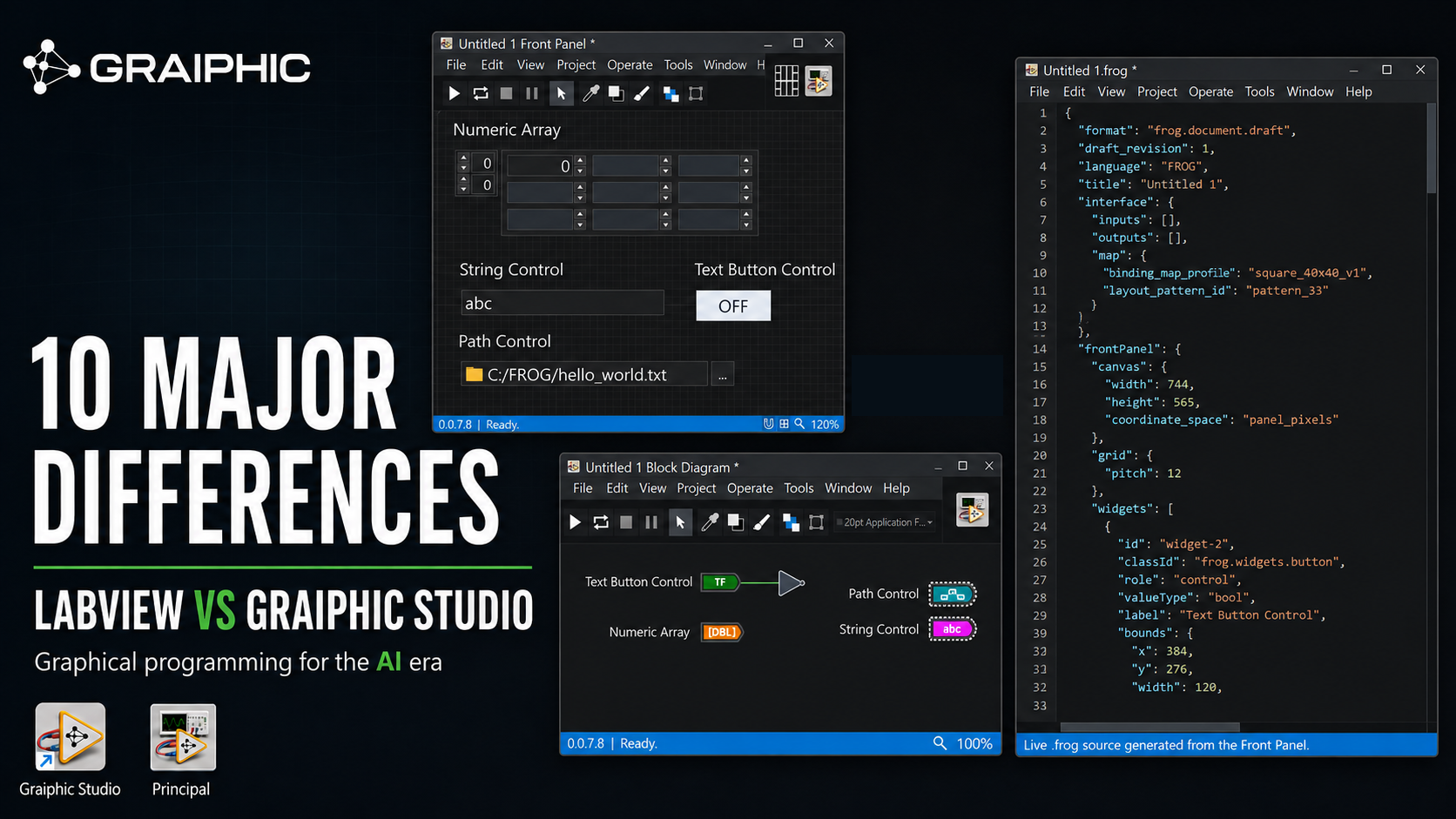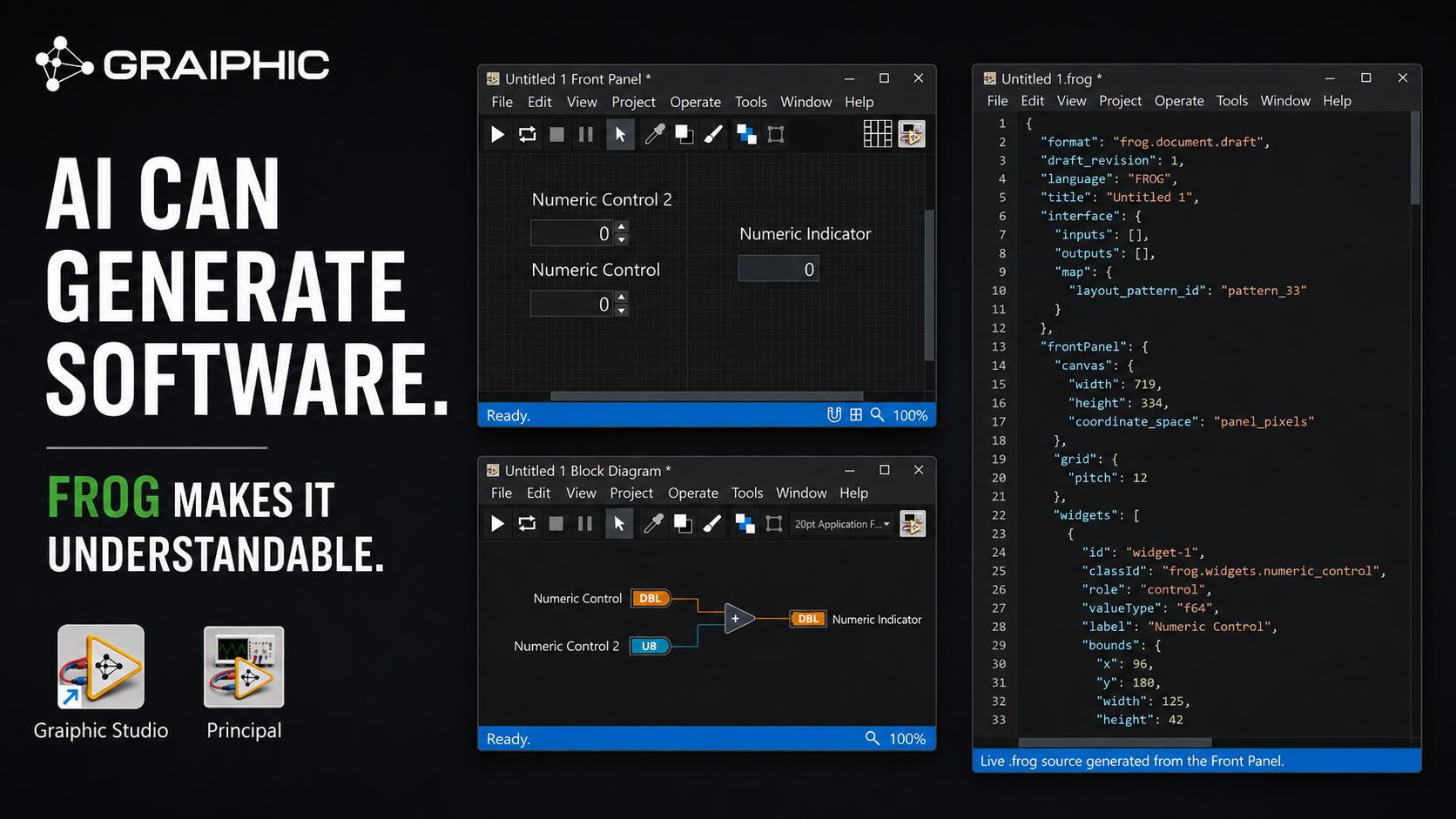

LabVIEW teams should not have to move the center of gravity of their applications into Python just to use modern artificial intelligence.
At Graiphic, we are building another path: keep LabVIEW at the center of the engineering system and make AI model execution as accessible as any other software or hardware component.
On August 31 and September 1, Graiphic will return to the
GLA Summit
to present the next stage of that work.
What Graiphic Will Show at a Glance
The session, SOTA: Modern AI Model Execution and Integration in LabVIEW, focuses on one practical objective: turning AI into a normal part of the LabVIEW engineering workflow.
LabVIEW-Centered Integration
Keep acquisition, orchestration, inference and application logic inside the architecture engineers already maintain.
Multiple Model Ecosystems
Work with ONNX models, native PyTorch workflows and SafeTensors-based model packages through a unified engineering approach.
High-Level Drivers
Use DeepMX, VisionMX and GraphMX to simplify model execution, vision workflows and computational graphs.
CPU-to-GPU Execution
Select execution providers according to the target hardware and performance requirements of the application.
Existing Architectures
Integrate inference into established LabVIEW applications instead of rebuilding the entire system around external scripts.
Complete Demonstrations
Follow the workflow from camera acquisition and processing to model execution, acceleration and application integration.
Twenty-Four Hours of Engineering Knowledge, Shared Globally
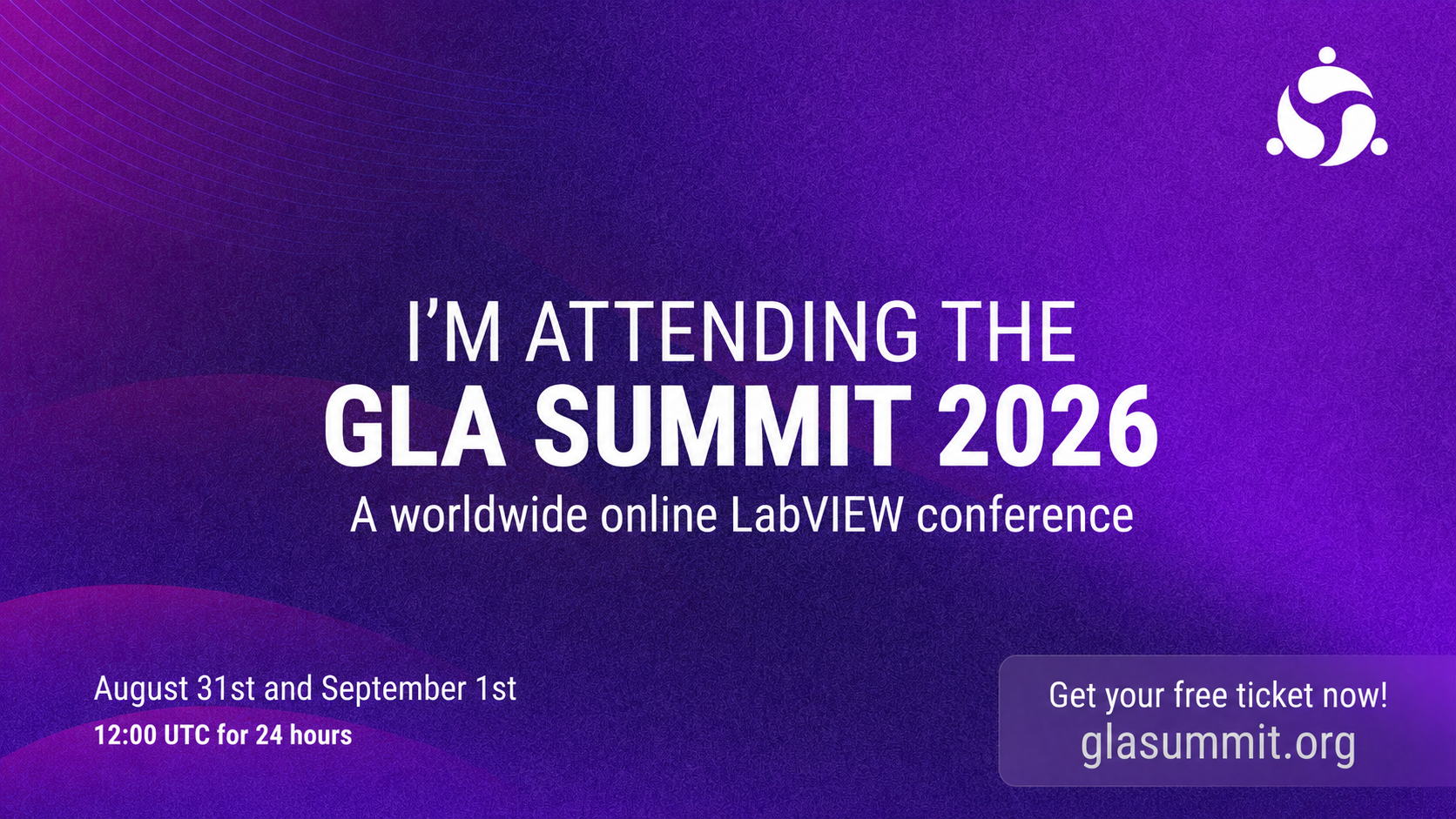
The GLA Summit is an all-digital conference created for advanced LabVIEW developers, architects and engineering teams around the world. The 2026 edition begins at 12:00 UTC on August 31 and continues for 24 hours, making the program accessible across time zones.
The event is free and built around technical presentations, practical experience and community exchange. Its format allows industrial developers, researchers, consultants and academic users to join the same conversation without travel becoming a barrier.
Graiphic participated in the 2025 program with SOTA: Modern Deep Learning Is LabVIEW Dataflow. In 2026, we are returning with a broader and more operational question:
From ONNX Runtime Integration to a Broader AI Engineering Ecosystem
SOTA initially concentrated on ONNX and ONNX Runtime. That foundation made it possible to execute interoperable AI models from LabVIEW and to connect model inference with the dataflow architectures already used in test, measurement, automation and research.
The ecosystem has since expanded. LabVIEW developers can now address a broader set of workflows involving ONNX, PyTorch and SafeTensors-based models, while retaining access to optimized runtimes and hardware-specific execution providers.
This progression matters because industrial AI is rarely limited to a single inference call. A production workflow may need to acquire an image, normalize data, execute a model, run post-processing, select a CPU or GPU backend, expose diagnostics and return results to an existing control or test sequence.
SOTA is being developed around that complete chain.
DeepMX, VisionMX and GraphMX: Three Drivers, One Workflow
The 2026 presentation will introduce three high-level entry points designed to reduce the amount of integration work required before an engineer can obtain a useful result.
DeepMX
DeepMX simplifies the loading, configuration and execution of AI models from LabVIEW. The objective is to make model inference feel like a standard engineering operation rather than a separate software project.
VisionMX
VisionMX connects image acquisition and computer-vision processing with the inference workflow, allowing camera data and visual preprocessing to remain part of the same LabVIEW application.
GraphMX
GraphMX simplifies the execution of computational graphs and processing pipelines, providing a structured route from data preparation to model execution and downstream computation.
“The goal of SOTA is not to create a separate AI environment around LabVIEW. It is to make AI a natural component of LabVIEW dataflow programming.”
LabVIEW Stays at the Center of the Application
AI prototypes often begin in notebooks. That is a productive environment for experimentation, training and model evaluation. The architectural difficulty appears later, when a production LabVIEW application must communicate with scripts, manage an external process, synchronize data, package several environments and maintain additional deployment boundaries.
Python is not the problem. Unnecessary architectural fragmentation is.
SOTA takes a different position: the model should adapt to the engineering system whenever possible, rather than forcing the engineering system to reorganize itself around the model’s original development environment.
This allows teams to preserve the structures they already understand—state machines, queued message handlers, Actor Framework applications, test sequences, machine-vision pipelines and custom industrial architectures—while introducing AI where it creates measurable value.
From Camera Input to Accelerated Inference
The presentation will move through the complete engineering workflow rather than treating each component as an isolated feature.
Acquire Data
Connect a camera and bring image data directly into the LabVIEW application.
Prepare the Input
Build the preprocessing path required by the selected AI model and application.
Load the Model
Configure an ONNX, PyTorch or SafeTensors-based workflow through the appropriate SOTA interface.
Select the Execution Hardware
Choose an available execution provider, from CPU processing to GPU acceleration.
Execute and Process the Result
Run inference, retrieve outputs and continue the computation through LabVIEW dataflow.
Integrate the Workflow
Insert the complete acquisition, processing and AI chain into an existing engineering application.
A Session for Teams Turning AI into Engineering Software
This presentation is designed for engineers who are less interested in isolated AI demonstrations than in the practical question of how models become reliable components of real systems.
Join Graiphic at GLA Summit 2026
Exact session time to be published
The Graiphic presentation is confirmed in the 2026 program. The organizers will publish its exact position in the final agenda.
Modern AI Should Become a Natural Part of LabVIEW Dataflow
Join Graiphic at GLA Summit 2026 to see how SOTA connects acquisition, computation, modern model ecosystems and hardware-accelerated execution inside a LabVIEW-centered workflow.
GLA Summit 2026 and the Graiphic Session
What is GLA Summit 2026?
GLA Summit is a free, all-digital conference for the worldwide LabVIEW community. The 2026 edition begins on August 31 at 12:00 UTC and runs continuously for 24 hours.
What will Graiphic present?
Youssef Menjour will present “SOTA: Modern AI Model Execution and Integration in LabVIEW,” a 45-minute session focused on ONNX, PyTorch, SafeTensors-based models, image acquisition, computational graphs and hardware-accelerated inference.
When is the Graiphic presentation?
The session is confirmed in the 2026 presentation program, but its exact time is not yet published. The official GLA Summit agenda will provide the final schedule.
Is registration free?
Yes. GLA Summit 2026 is a free online event. Registration is available through the official event platform.
Does the session require Python expertise?
No. The session is specifically about integrating modern AI workflows into LabVIEW without requiring teams to redesign their production applications around Python scripts, notebooks or separate environments.