
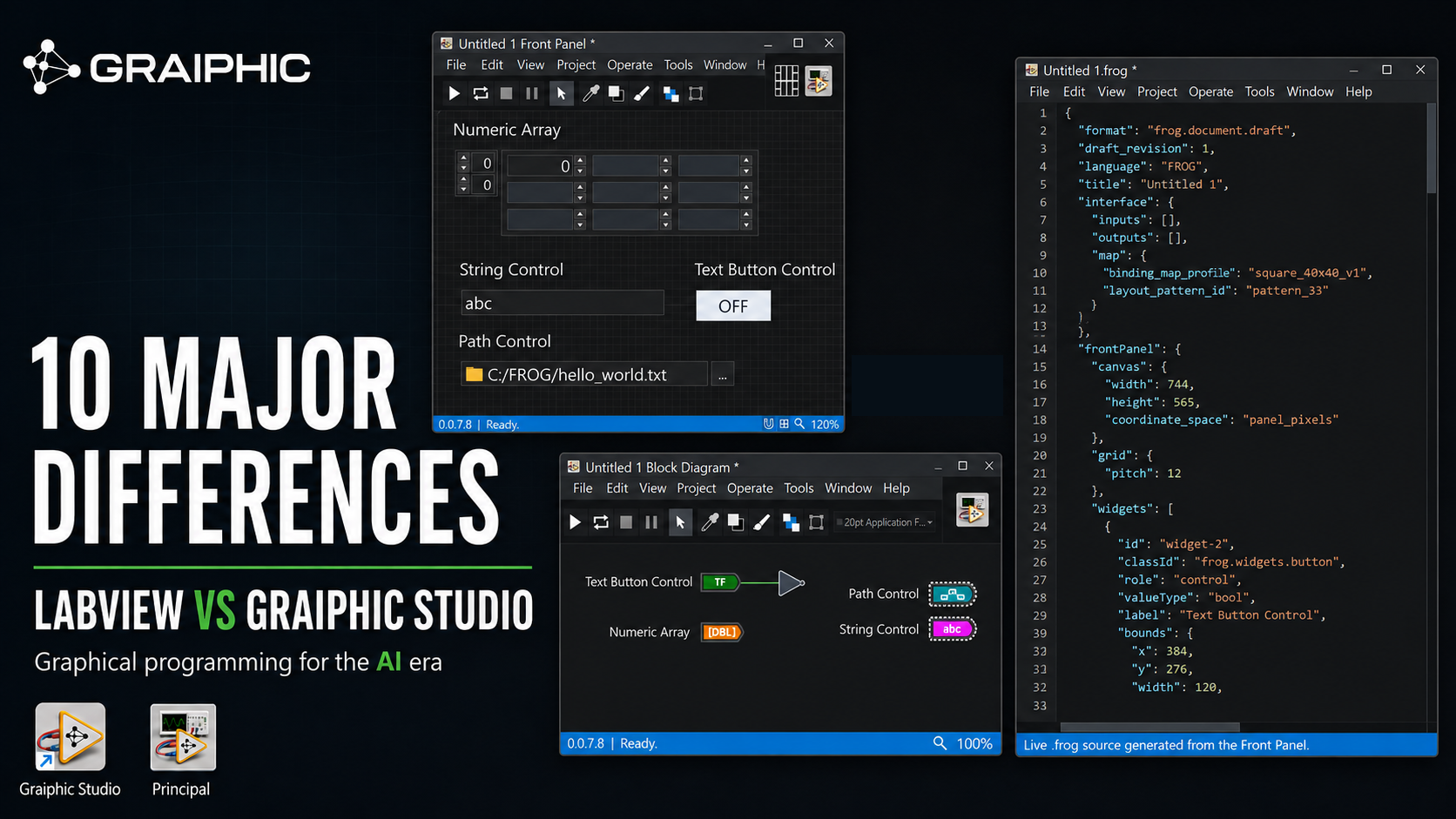
LabVIEW proved that graphical programming could leave the classroom, enter the laboratory, control real instruments and power industrial systems.
That achievement matters.
Graiphic Studio does not exist because graphical dataflow failed.
It exists because graphical dataflow succeeded — and because the software world around it has radically changed.
Git became the standard collaboration layer for software engineering. Artificial intelligence began generating code. Hardware platforms became increasingly heterogeneous. Industrial users started demanding greater transparency, portability, auditability and technological sovereignty.
The question is therefore no longer whether graphical programming works.
What should graphical programming become in the age of AI, structured source and modular execution?
This is the question behind
Graiphic Studio
and
FROG — Free Open Graphical Language.
This article is not a feature-count contest.
LabVIEW is a mature industrial platform backed by decades of development, hardware integrations, deployment tooling and production experience. Graiphic Studio is a new environment under active development.
The comparison below focuses on something more fundamental: the architectural choices behind each environment.
10 Differences at a Glance
These differences are not cosmetic changes. They reveal two different generations of graphical software architecture.
AI-Era Architecture
Structured source for machines and AI, combined with graphical inspection for engineers.
Readable and Protectable Source
Versionable .frog authoring source, with optional protection planned for proprietary distribution.
Modern Git Workflows
Standard source diffs, pull-request reviews and CI access during engineering, without requiring public disclosure.
Three Coordinated Views
Front Panel, Block Diagram and live Source View remain synchronized around the same program.
API Independent from UI
Public program inputs and outputs are defined independently from the user-facing Front Panel.
The IDE Is Not the Language
Graiphic Studio consumes the public FROG language contracts instead of privately defining the language alone.
Explicit Execution Pipeline
Source, validation, FIR, lowering and backend contracts remain distinct and inspectable.
Runtime and Compiler Paths
The architecture supports runtime-oriented, compiler-oriented and hybrid execution strategies.
Source-Backed Widgets
Widget classes, behavior, SVG realizations and package metadata are explicit architectural layers.
An Open IDE Ecosystem
Graiphic Studio is designed to be a leading FROG environment, not the only place where FROG can exist.
1. AI Is Not a Plugin. It Is an Architectural Constraint.
AI assistance can be added to almost any development environment.
A chatbot can explain a function. A model can search documentation. An assistant can suggest an implementation.
FROG goes one level deeper.
Machines must be able to generate the program, while humans must remain able to inspect the system.
The LabVIEW strength
LabVIEW programs are naturally visual. Engineers can inspect wires, structures, terminals, loops and data movement directly on the Block Diagram.
This remains one of the greatest strengths of graphical dataflow.
The FROG shift
FROG combines that graphical inspectability with a structured, machine-readable source representation.
An AI-assisted system can eventually generate or transform explicit objects such as typed nodes, ports, directed connections, control structures, widgets, public interfaces and source metadata.
An engineer can then inspect the resulting graph instead of receiving only a large block of generated textual code.
FROG does not claim that generated software becomes automatically correct, safe or secure.
Generated software should not have to remain opaque.
2. Readable by Design. Protectable by Choice.
One of FROG’s foundational principles is that a graphical program should have a canonical source representation that engineering tools can understand.
LabVIEW
A LabVIEW VI is stored as a binary artifact. NI therefore provides dedicated graphical comparison and merge tools for revision-control workflows.
A developer cannot open a .vi in a conventional text editor and directly inspect its complete program structure.
Graiphic Studio and FROG
A FROG program is authored through a structured JSON document using the .frog extension.
During development, collaboration, review and continuous integration, a .frog document can remain readable and versionable.
The source can explicitly describe document metadata, the public interface, Front Panel widgets, Diagram nodes, ports, typed connections, bindings and other source-owned information.
This enables Git reviews, automated validation, dependency analysis, migration tools and AI-assisted transformations.
However, an open language does not mean that every application created with that language must be distributed as readable source code.
FROG separates the openness of the language from the confidentiality of the application.
The FROG language specification and canonical source model are open, while project owners retain control over the applications they create.
Graiphic plans to provide an optional protection mechanism for teams that need to distribute proprietary FROG applications without exposing their complete source representation.
The final technical mechanism has not yet been defined and should therefore not currently be described as a specific encryption, obfuscation or packaging technology.
3. Git Can Read the Graph — Without Forcing You to Publish It
Storing a graphical program in Git and making that program genuinely understandable to Git are two different things.
LabVIEW
Git can store VI files, but standard textual diff and merge utilities cannot represent their graphical modifications directly. LabVIEW teams generally configure dedicated tools such as LVCompare and LVMerge.
Graiphic Studio
When a project is maintained in its readable .frog source form, standard development platforms can display source changes, review modified fields, run validation in CI, inspect dependencies and provide structured context to software tools or AI assistants.
A future graphical comparison tool can still provide a richer high-level review of visual modifications.
Git-native during engineering. Protectable for distribution.
4. One Program. Three Synchronized Views.
LabVIEW
A VI is primarily represented through two coordinated surfaces: the Front Panel and the Block Diagram.
Graiphic Studio
Graiphic Studio adds a third first-class surface:
- Front Panel — the user-facing interface.
- Block Diagram — the executable dataflow graph.
- Source View — the live
.frogdocument.
All three views reflect the same in-memory Program Model.
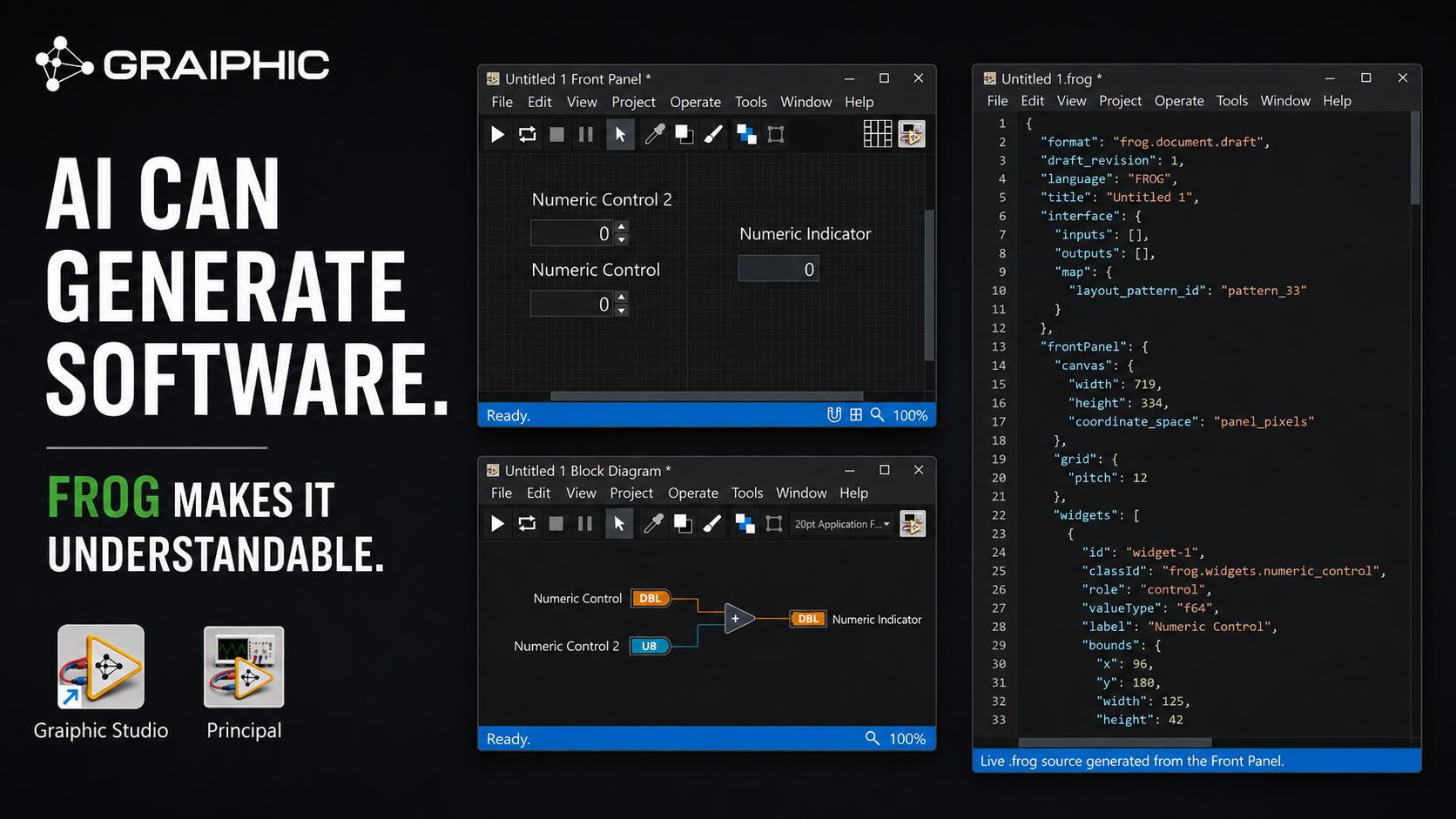
Place a Numeric Control on the Front Panel. Its typed terminal appears on the Block Diagram. Its class, role, representation, geometry and properties appear in the Source View.
Design visually. Build the graph. Inspect the source. Never leave the same program.
5. Your Public API Is No Longer Your User Interface
LabVIEW
The Connector Pane exposes a VI as a reusable subVI. Its terminals are assigned to controls and indicators placed on the Front Panel.
FROG
A FROG public interface is defined independently from its Front Panel.
A program can declare typed public inputs and outputs even when it has no user interface. Graiphic Studio then provides an Interface Map that explicitly binds compatible Front Panel widgets to those public ports.
API first. UI second. Binding explicit.
This separation opens the way to headless FROG components, reusable graphical libraries, alternative user interfaces and stable public contracts independent from one visual layout.
6. The IDE Is Not the Language
LabVIEW
LabVIEW is a deeply integrated product stack. The graphical language, development environment, compilation technologies, deployment tools and runtime families are delivered within one coherent NI ecosystem.
FROG and Graiphic Studio
FROG is a public graphical language specification. Graiphic Studio is a professional development environment built around that specification.
The editor does not privately own the canonical source format, language semantics, public interface model, execution-facing FIR, runtime contracts or compiler contracts.
The editor can evolve. The runtime can change. The program remains anchored in a public language contract.
7. The Journey from Graph to Machine Stays Explicit
A visual graph is only the beginning of execution. The program must still be validated, transformed, prepared and consumed by a runtime or compiler.
LabVIEW
LabVIEW manages its compilation and execution chain as part of the NI product architecture.
FROG
The FROG architecture publishes an explicit conceptual corridor:
.frog sourceFIR — the FROG execution-facing intermediate representation — is intended to remain inspectable and act as a public bridge between validated graphical meaning and downstream execution technology.
There should be no mysterious jump between the graph engineers understand and the artifact the machine executes.
8. Runtime or Compiler? Why Choose?
LabVIEW
LabVIEW supports several execution and deployment models across desktop, real-time and FPGA targets. These paths are delivered within the NI ecosystem with target-specific compilation and runtime requirements.
FROG
FROG treats runtime execution and native compilation as complementary downstream strategies that can begin from the same language and execution-facing representation.
A runtime-oriented path can provide live execution, Front Panel hosting, state management, diagnostics, probes and operational services.
A compiler-oriented path can provide target-specialized artifacts, native execution, smaller dependency closures and hardware-oriented optimization.
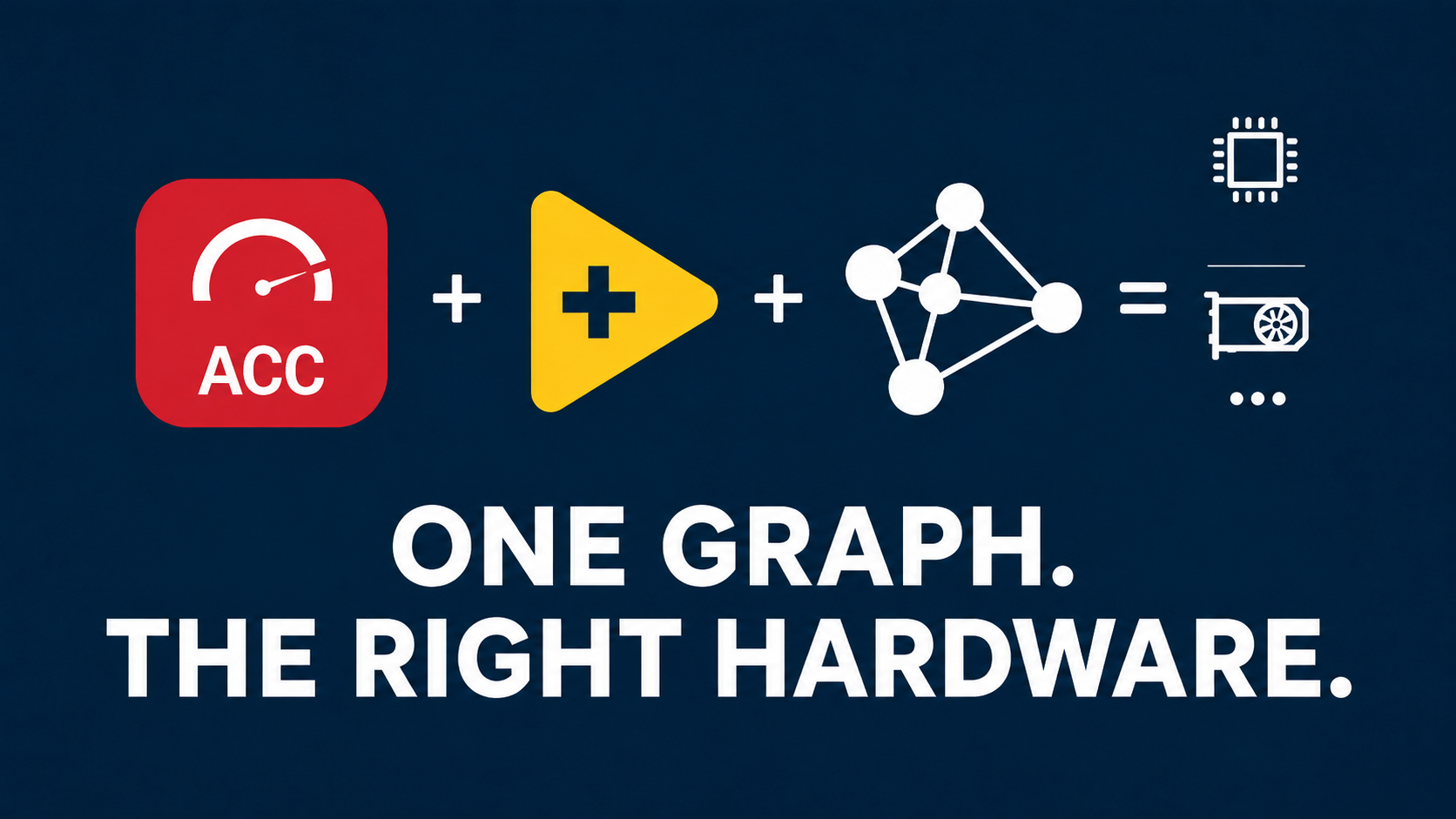
One graph. Multiple execution destinies.
9. Widgets Become Source-Backed Packages
LabVIEW
LabVIEW provides a Control Editor for creating and saving custom controls and indicators, with reusable .ctl files and type definitions.
FROG
FROG separates the different layers of a widget more explicitly:
- Widget class identity.
- Values and data types.
- Properties.
- Methods and events.
- Behavior contracts.
- Visual parts.
- SVG realization assets.
.wfrogpackage metadata.- Instances stored in a
.frogdocument.
The widget is no longer just a control dropped from a palette. It becomes a versioned architectural package.
10. Graiphic Studio Is the First FROG IDE, Not the Last
Graiphic is investing heavily in Graiphic Studio.
It is our product, our engineering effort and our vision for a modern FROG development experience.
But Graiphic Studio is deliberately not defined as the FROG language itself.
The wider architecture separates the language specification, editors, conformance tools, runtimes, compilers, libraries and hardware bridges.
Other editors, runtimes or compiler families could ultimately consume the same public source and contracts.
Graiphic Studio is designed to be the best place to build FROG — not the only place where FROG can exist.
Not a Clone. Not a Rejection. A New Generation.
Graiphic Studio is not being built by pretending that the history of graphical programming does not exist.
It is being built because that history demonstrated something important: engineers can express complex systems through explicit visual dataflow.
LabVIEW proved that idea at industrial scale.
Graiphic Studio asks what comes next.
What happens when graphical programming gains:
- A readable canonical source format?
- Optional protection for proprietary distribution?
- Native compatibility with modern Git workflows?
- An architecture designed for AI generation and human inspection?
- A public language independent from one IDE?
- An open execution-facing intermediate representation?
- Modular runtime and compiler strategies?
- Source-backed widgets and explicit interface contracts?
The answer is not simply a more modern graphical editor.
It is a new architectural foundation for graphical software engineering.
What This Means for Engineers
These differences are intended to produce practical engineering benefits:
- More transparent project reviews.
- Better integration with Git and CI pipelines.
- Clearer separation between API, logic and user interface.
- Greater control over deployment architecture.
- Improved compatibility with AI-assisted authoring.
- Long-term maintainability beyond one editor version.
- Optional confidentiality for proprietary applications.
- More explicit transitions from source to execution.
What Exists Today
Graiphic Studio remains under active development.
The current product already demonstrates:
- Coordinated Front Panel and Block Diagram windows.
- A live
.frogSource View. - Typed widgets and Diagram terminals.
- Widget and Function Navigators.
- Public Interface Map bindings.
- An integrated vector Icon Editor.
- Context Help connected to widgets and functions.
- Explicit document dependencies.
- A growing surface of published FROG operations.
The production runtime, compiler corridors, broader function coverage, protected distribution mechanism, deployment workflows and future platform support continue to progress.
The foundations are real. The ambition is larger than the current implementation.
What Comes Next
Starting in September 2026, Graiphic will begin publishing more detailed demonstrations of Graiphic Studio and FROG.
These demonstrations will move the conversation from architecture to visible proof.
LabVIEW built the graphical revolution.
Graiphic Studio is building what graphical programming can become next.
Discover the Next Era of Graphical Programming
Explore Graiphic Studio, inspect the public FROG language specification and follow Graiphic as the first detailed demonstrations approach.
Frequently Asked Questions
Is Graiphic Studio intended to replace LabVIEW immediately?
Is Graiphic Studio a LabVIEW clone?
.frog source, a live Source View, an independent public interface and a modular execution architecture.Can Graiphic Studio open LabVIEW VI files?
.frog document use different source models, semantics and execution contracts.Is FROG open source?
Does using FROG require publishing my application source code?
Is source protection already available?
Is Graiphic Studio already production-ready?
Does FROG already support every operating system and hardware target?
Why compare Graiphic Studio with LabVIEW?
Sources and Further Reading
Graiphic and FROG
- FROG public language specification
- Graiphic Studio documentation
- Graiphic Studio public documentation repository
- FROG — Format-first, not IDE-first
- FROG — AI generation compatibility and inspectability