
AI can now generate more software in seconds than an engineering team can reasonably inspect in hours.
That changes the software problem.
The next bottleneck will not be our ability to produce code. It will be our ability to understand it, inspect it, validate it, maintain it and remain accountable for what it does.
For a disposable prototype, opacity may be inconvenient.
For software connected to instruments, machines, vehicles, production systems or physical infrastructure, opacity is unacceptable.
This is why Graiphic is building FROG .
AI can generate code. FROG is designed to keep the system visible.
The Software Problem Just Changed
For decades, software development was constrained primarily by the time required to write code.
Generative AI is rapidly reducing that constraint.
Models can produce functions, interfaces, tests, documentation and complete application structures at a speed that would have appeared impossible only a few years ago.
This acceleration is powerful. It also creates a new imbalance.
Software production is becoming abundant, while responsible understanding remains expensive.
A generated system must still be reviewed. Its data movement must still be understood. Its interfaces, states, dependencies and failure modes must still be identified. Its behavior must still be validated before it reaches a real machine.
More generated code does not remove engineering responsibility.
It increases it.
FROG Is Not Another Visual IDE
FROG stands for Free Open Graphical Language.
It is an open, hardware-agnostic graphical dataflow programming language designed to represent software as explicit executable graphs.
A FROG program is expressed through elements such as:
- Typed nodes.
- Typed input and output ports.
- Directed dataflow connections.
- Explicit control structures.
- Visible public interfaces.
- Optional user-interface widgets.
- Explicit state and memory semantics.
- Inspection and observability surfaces.
The central idea is not simply to replace lines of text with boxes and wires.
It is to define a complete graphical language architecture in which the source, its meaning, its execution-facing representation and its deployment paths remain explicit.
FROG is therefore not a graphical skin placed over an existing programming language.
It is an attempt to open the language layer of graphical programming itself.
The IDE Is Not the Language
This is one of the most important principles behind FROG:
The IDE is not the language.
Many graphical programming environments historically combine the editor, saved format, runtime, compiler and hardware ecosystem into one inseparable product stack.
This can provide a convenient integrated experience, but it also creates a long-term dependency: the program remains understandable and executable only as long as the complete proprietary chain continues to exist.
FROG takes a different approach.
Its durable public asset is the language pipeline:
canonical .frog source ↓ structural validation ↓ semantic validation ↓ validated program meaning ↓ open execution-facing FIR ↓ lowering and backend contract ↓ runtime, compiler or hardware bridge
The editor can evolve.
The runtime can be specialized.
A compiler can target a different execution family.
None of them should silently become the permanent owner of the program’s meaning.
A Graphical Program with a Real Source File
A graphical language still needs a durable source representation.
In FROG, that representation is the .frog file.
A .frog document is structured JSON designed to describe the program, including its interface, widgets, executable graph, types, connections, layout and source-owned metadata.
This provides something historically difficult to achieve in graphical programming:
- A source file that can be stored in Git.
- A source file that can be compared through a diff.
- A source file that can be inspected without opening one specific IDE.
- A source file that can be structurally validated.
- A source file that can be generated and transformed by software tools.
- A source file that remains connected to a graphical representation.
The result is a combination that is particularly relevant in the AI era:
structured source for machines and AI + explicit graphical structure for engineers
One Program. Three Coordinated Views.
FROG is the language.
Graiphic Studio is the visual development environment being created by Graiphic to author and inspect FROG programs.
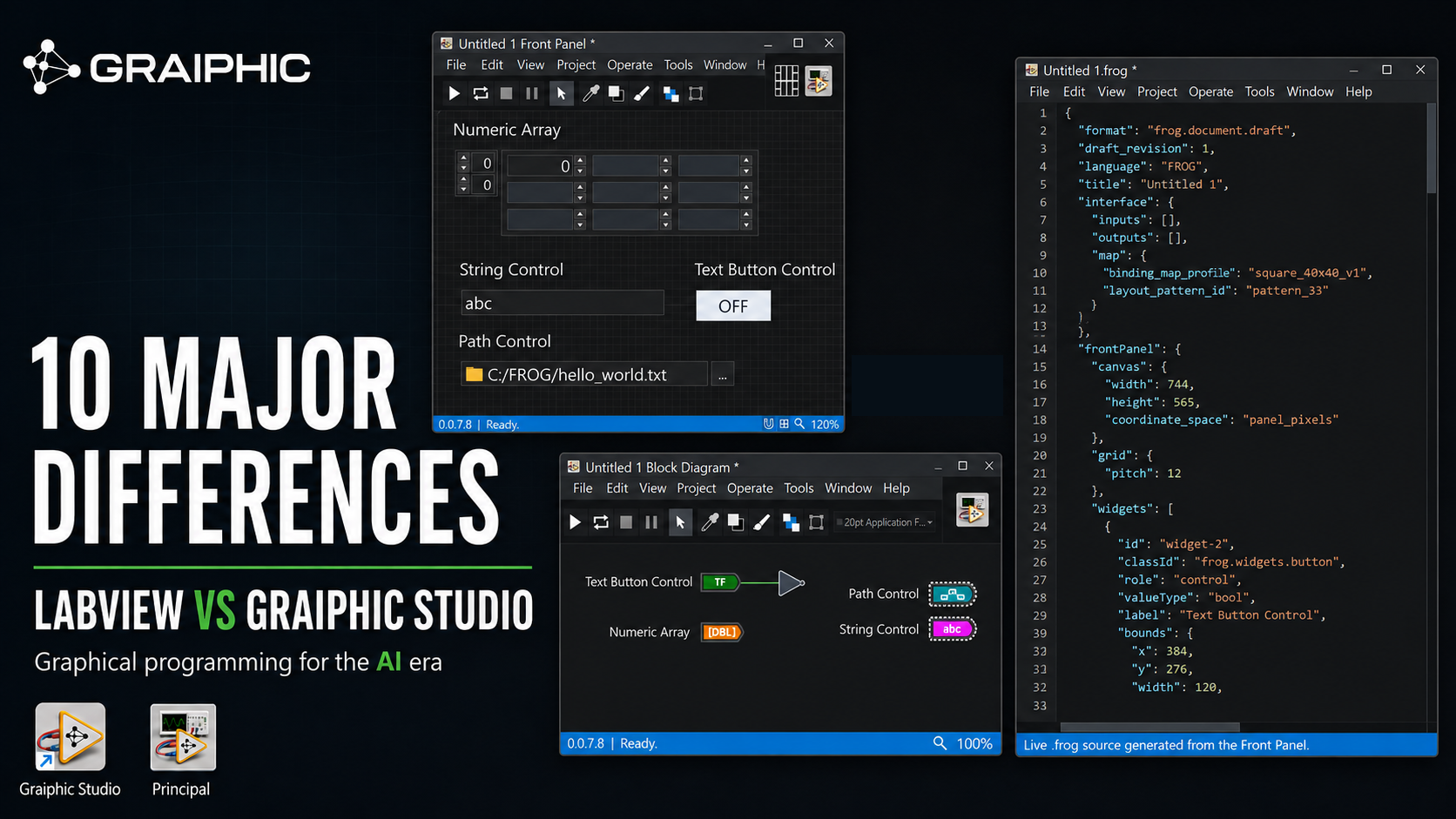
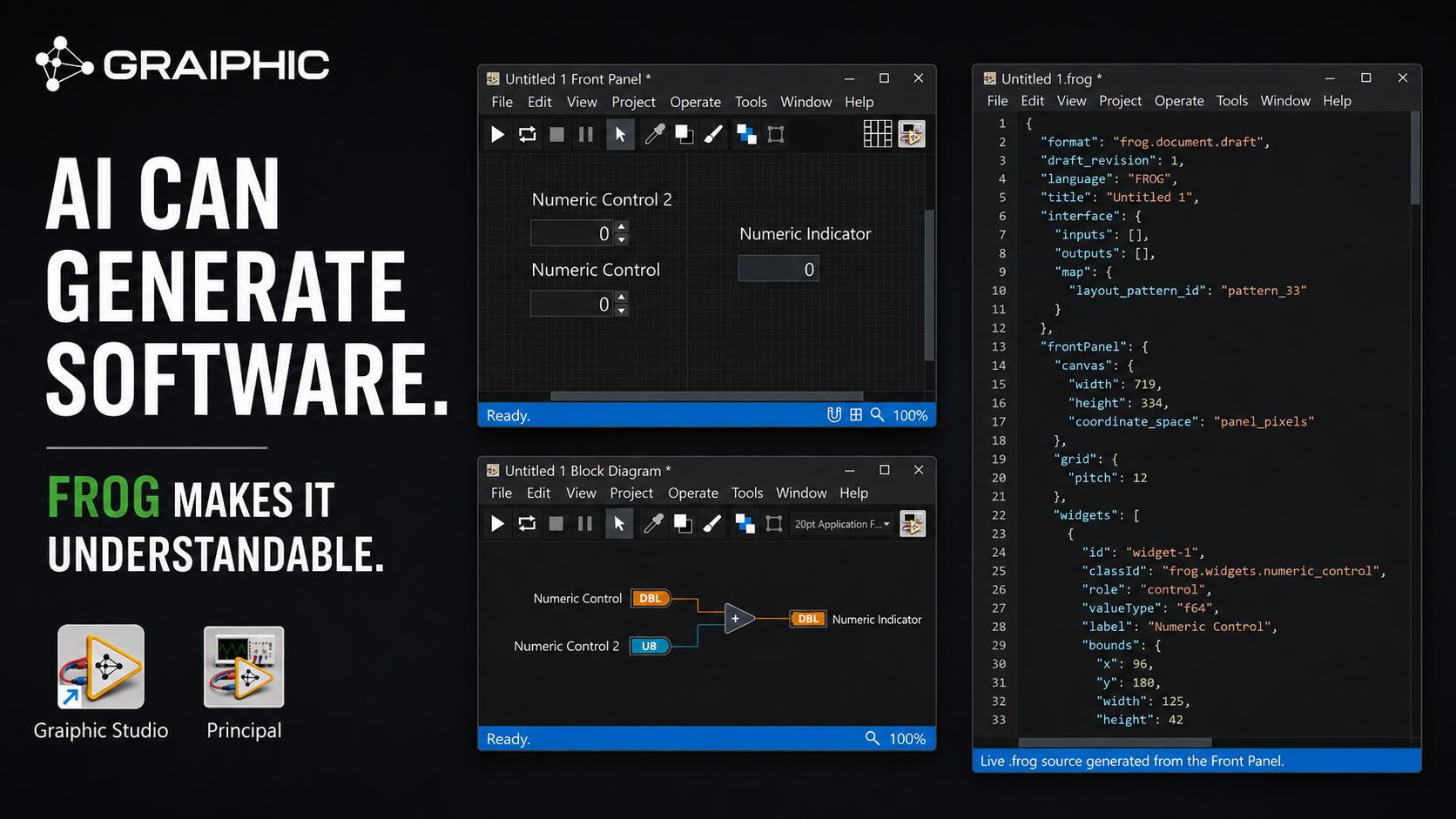
It presents one .frog document through three coordinated views.
Front Panel
The Front Panel defines the application’s user-facing interface.
It contains controls, indicators, labels, images, containers and public interface bindings.
Block Diagram
The Block Diagram defines the executable dataflow.
It contains typed terminals, operations, structures and the connections that describe how information moves through the system.
Source View
The Source View exposes the live .frog representation produced by the current document.
It allows developers to inspect object identities, types, bindings, properties, graph nodes, connections and authored layout directly.
These are not three unrelated files.
They are three coordinated projections of the same program model.
Place a widget on the Front Panel. See its typed terminal on the Diagram. Inspect the corresponding source immediately.
That synchronization is one of the most tangible expressions of the FROG philosophy: graphical convenience without hidden source truth.
Built for the Age of Generated Software
Textual programming languages are naturally compatible with modern AI systems.
A model can emit Python, C++ or Rust as plain text.
But understanding the resulting system often remains a linear exercise: engineers inspect files, functions and call chains while trying to rebuild the global architecture mentally.
Historical graphical environments offer a different strength. Their behavior can be easier to inspect visually because data movement and system structure are represented directly.
However, they are often less compatible with AI generation because their saved formats and internal representations are not designed as open, structured source.
FROG is designed to combine both properties:
- AI generation compatibility through structured, machine-readable source.
- Human inspectability through explicit graphical dataflow.
An AI tool could generate or transform a structured FROG program.
An engineer could then inspect its graph, types, public interfaces, dependencies and execution-facing artifacts before approving the result.
This does not make generated software automatically correct.
It makes it less opaque.
Inspectability Is Not Correctness — and That Is the Point
No language can guarantee that every program created with it is safe, correct or secure.
Graphical form alone does not eliminate software defects.
FROG makes a more precise claim.
It is designed to expose structure.
Nodes, ports, connections, interfaces, state, source, validation results and execution-facing representations can remain visible as distinct artifacts.
This gives engineering teams stronger surfaces for:
- Review.
- Testing.
- Validation.
- Traceability.
- Auditing.
- Controlled evolution.
In other words, FROG does not attempt to replace engineering judgement.
It attempts to give that judgement a clearer system to inspect.
What Happens Between Source and Execution Should Not Disappear
A recurring problem in modern development environments is that important transformations happen inside opaque tooling.
The source enters a compiler or runtime, and the resulting execution path is difficult to inspect at the same level of meaning as the original program.
FROG introduces an open execution-facing intermediate representation: FIR.
FIR is intended to provide a public bridge between validated program meaning and downstream execution systems.
This separation allows several execution strategies to coexist:
- A runtime-oriented path for live execution, state management, diagnostics and interactive interfaces.
- A compiler-oriented path for native or optimized target artifacts.
- A hybrid path combining compiled computation with runtime services.
- Hardware or vendor bridges connected through explicit downstream contracts.
FROG does not force the language to become permanently identified with one runtime or one compiler.
The language remains upstream.
Deployment remains modular.
Why This Matters for Industry
Industrial software frequently outlives the tools and teams that originally created it.
A production machine, measurement system, laboratory platform or embedded controller may remain operational for ten, fifteen or twenty years.
During that lifecycle, the organization may need to:
- Replace hardware.
- Change operating systems.
- Update drivers.
- Audit critical behavior.
- Add AI-generated functionality.
- Transfer maintenance to another engineering team.
- Qualify a new runtime or execution target.
A language architecture based on open source artifacts and explicit contracts can provide several strategic advantages.
| Industrial requirement | FROG design response |
|---|---|
| Long-term maintainability | Canonical source remains distinct from one editor or runtime. |
| Auditability | Graph structure, interfaces and execution-facing artifacts remain inspectable. |
| Portability | The language is designed to remain upstream from individual hardware and backend families. |
| AI-assisted development | Structured source can be generated while remaining graphically reviewable. |
| Technological sovereignty | The public language definition is not inseparable from one proprietary product stack. |
| Heterogeneous execution | Runtime, compiler and hardware bridges can consume explicit downstream contracts. |
Graiphic Studio: Where FROG Becomes Tangible
A language specification creates the foundation.
A serious development environment turns that foundation into an engineering experience.
Graiphic Studio is being designed around the public FROG source model rather than using an editor-private representation as the permanent source of truth.
Its developing authoring environment includes:
- A coordinated Front Panel and Block Diagram.
- A live Source View.
- A Widget Navigator for interface components.
- A Function Navigator for executable operations.
- An Interface Map for typed public inputs and outputs.
- An integrated vector Icon Editor.
- Context Help connected to typed objects and functions.
- Typed controls, indicators, arrays and diagram terminals.
- Explicit document dependencies and reusable FROG components.
The objective is not to hide complexity behind a simplified no-code interface.
It is to move complexity toward the system being designed rather than the syntax required to express it.
Engineers should be able to focus on:
- What data exists.
- Where it moves.
- Which interfaces are public.
- What state is retained.
- Which operations execute.
- How the system is observed.
- Where the application will ultimately run.
Open Language, Professional Engineering
Opening the language does not reduce the engineering challenge.
It makes the challenge more ambitious.
Graiphic engineers are working across several connected fronts:
- Language specification.
- Canonical source design.
- Semantic validation.
- Graphical editor architecture.
- Typed dataflow and binding systems.
- Widget and interface contracts.
- Runtime boundaries.
- Compiler-facing representations.
- Performance and portability.
- Conformance and regression testing.
FROG is one of the most ambitious engineering programs undertaken by Graiphic.
It is not built around one spectacular demonstration.
It is being built as an architecture intended to survive beyond the first demonstration.
What Exists Today
FROG is no longer only an idea or presentation.
The public project already includes:
- The open FROG language specification.
- The canonical
.frogsource model. - Language and validation contracts.
- An open FIR architecture.
- Public examples and conformance material.
- Widget, interface and source-format definitions.
- Bounded reference execution paths.
- Public documentation for Graiphic Studio.
At the same time, the project remains under active development.
Graiphic Studio, the production runtime, broader function coverage, deployment paths and future target support are still progressing.
That distinction matters.
The foundations are real.
The ambition is larger than the current implementation.
And the next step is to make that progress visible.
In September, We Stop Describing FROG and Start Showing It
Until now, much of FROG’s public story has been architectural.
Source formats. Language boundaries. FIR. Validation. Runtime and compiler separation. AI inspectability.
Those foundations are essential, but software ultimately needs to be seen in motion.
In September 2026, Graiphic will begin publishing new demonstrations of FROG and Graiphic Studio.
They will show how one program moves across its coordinated Front Panel, Block Diagram and Source views.
They will show typed widgets and operations becoming explicit source.
They will show how graphical software can remain visual without becoming opaque.
And they will begin turning the architectural promise of FROG into visible, testable proof.
The next era of software will not be defined only by how quickly we can generate programs.
It will be defined by whether humans can still understand and govern them.
FROG is Graiphic’s answer to that challenge.
The language is open.
The graph is explicit.
The source is inspectable.
And this is only the beginning.
Frequently Asked Questions
Is FROG an IDE?
No. FROG is an open graphical dataflow language specification. Graiphic Studio is an authoring environment being developed for creating and editing FROG programs.
What is a .frog file?
A .frog file is the canonical structured source representation of a FROG program. It uses JSON to describe source-owned elements such as interfaces, widgets, graph nodes, connections, types and layout.
Is FROG open source?
The public FROG language specification is published on GitHub under the Apache License 2.0. Graiphic may also develop proprietary products, runtimes and professional tooling that implement or extend the public language contracts.
Is FROG intended to replace textual programming languages?
FROG is not presented as a universal replacement for every textual language. It is designed for applications where explicit dataflow, visual system structure, inspectability, modular execution and industrial integration provide significant value.
Does FROG make AI-generated software automatically safe?
No. FROG does not make generated software automatically correct or secure. Its architecture is designed to reduce opacity by making source, graph structure, interfaces, validation and execution-facing artifacts more explicit.
Does FROG already run on every hardware platform?
No. FROG is designed to remain hardware-agnostic at the language level, but individual runtimes, compiler bridges and hardware targets require separate implementations and validation.
What is FIR?
FIR is FROG’s open execution-facing intermediate representation. It is intended to provide an inspectable bridge between validated program meaning and downstream runtimes, compilers or hardware integrations.
When will Graiphic Studio demonstrations be available?
Graiphic plans to begin publishing new FROG and Graiphic Studio demonstrations in September 2026.