
Opening the Language Layer of Industrial Graphical Programming
For decades, graphical programming has occupied a very special place in industrial software.
It allowed engineers to build measurement systems, test benches, automation logic, instrumentation software, and control applications without thinking only in lines of text.
Instead of forcing every idea through syntax first, it made software visible: data moved from one node to another, behavior could be inspected, and complex systems could be understood as diagrams.
That is why environments such as LabVIEW became so important.
LabVIEW proved that graphical dataflow programming could be serious, productive, and deeply useful in the real world. It gave engineers a way to connect software logic with hardware, instruments, sensors, acquisition systems, and user interfaces in a highly practical way. Its strength was not just that it was visual. Its strength was that it matched the mental model of many engineers: signals, flows, instruments, inputs, outputs, timing, and observable behavior.
But this historical success also exposed a structural limitation. In most graphical industrial environments, the language, the editor, the saved file format, the runtime, the compiler path, the hardware ecosystem, and the vendor stack are tightly coupled. This can be very efficient when everything stays inside the same ecosystem. But over time, it creates friction: portability becomes harder, long-term openness becomes limited, independent implementations become almost impossible, and the language itself cannot easily become a shared industrial foundation.
This is the space where FROG is being built.
FROG — Free Open Graphical Language — is not an attempt to imitate an existing tool screen by screen. It is an attempt to open the language layer of graphical industrial programming itself.
Why the Language Layer Matters
When people think about graphical programming, they often think first about the editor: the blocks, wires, panels, colors, controls, indicators, and diagrams. Those things matter, but they are not the deepest layer.
The deeper layer is the language model:
- How is a program represented?
- How are nodes, ports, connections, types, states, loops, and interfaces described?
- How does a graphical program become executable?
- How can it be validated?
- How can it be inspected?
- How can it be transformed without losing meaning?
- How can it target different runtimes, compilers, or hardware families?
If that layer is closed, the entire ecosystem remains dependent on one implementation. If that layer is open, something very different becomes possible: multiple tools, multiple runtimes, multiple compilers, multiple front ends, and multiple industrial workflows can share the same language foundation.
This is the central idea behind FROG.
FROG separates the graphical language from the product that may edit it, run it, compile it, or deploy it. That separation is not an academic detail. It is what allows graphical programming to become an open industrial infrastructure rather than a feature inside one vendor environment.
What FROG Is Trying to Preserve from LabVIEW
It would be a mistake to talk about FROG without acknowledging what LabVIEW got right.
LabVIEW made software intuitive for engineers who think in systems. It connected computation with acquisition, hardware, test logic, control panels, and operational reality. It gave industry a way to build serious applications quickly, especially in test, measurement, automation, and instrumentation.
The best parts of that world are worth preserving:
- programs that can be understood visually;
- dataflow as a natural execution model;
- strong correspondence between software structure and physical systems;
- front panels that make execution observable and interactive;
- fast development cycles for engineers close to the machine;
- a practical bridge between software and real industrial hardware.
But the next generation of graphical industrial programming needs more openness. It needs open source representation, explicit intermediate representations, auditable transformations, modular runtime paths, compiler bridges, and long-term portability beyond one proprietary stack.
FROG is being developed from that observation.
The objective is not to deny the value of historical graphical tools. The objective is to take the strongest idea — graphical dataflow as a serious engineering language — and give it a modern open foundation.
From Diagram to Execution: The FROG Philosophy
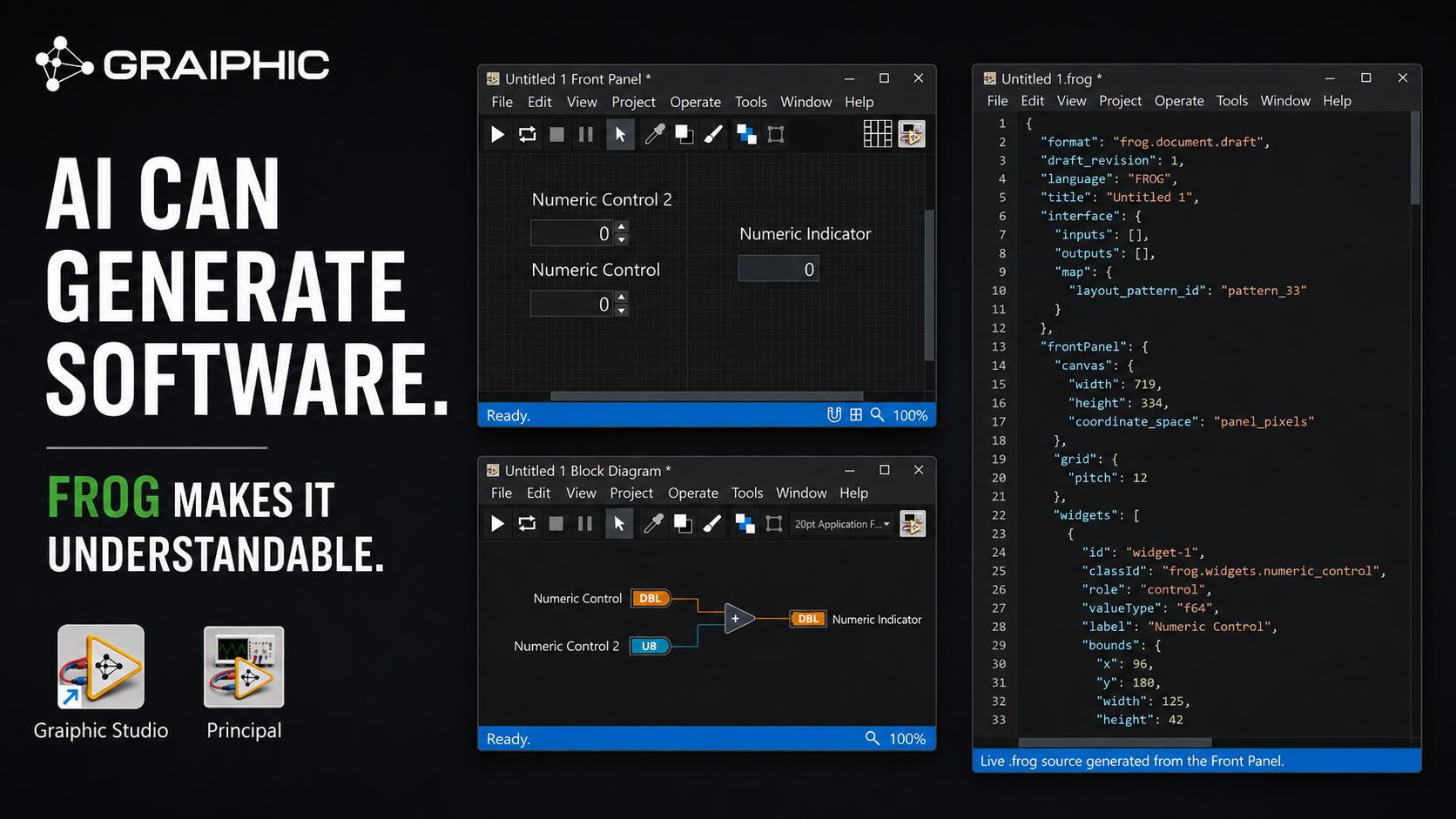
A FROG program starts from an open graphical source representation. In practical terms, the canonical source is a structured .frog artifact. Instead of hiding the program inside a proprietary binary format, the program can be represented as explicit data: nodes, ports, connections, interfaces, control structures, and metadata.
That matters because industrial software should not only run. It should be inspectable.
A simplified FROG execution philosophy looks like this:
.frog source
  -> validated meaning
  -> FIR
  -> lowering
  -> backend contract
  -> runtime or compiler execution
This chain may sound technical, but the idea is simple.
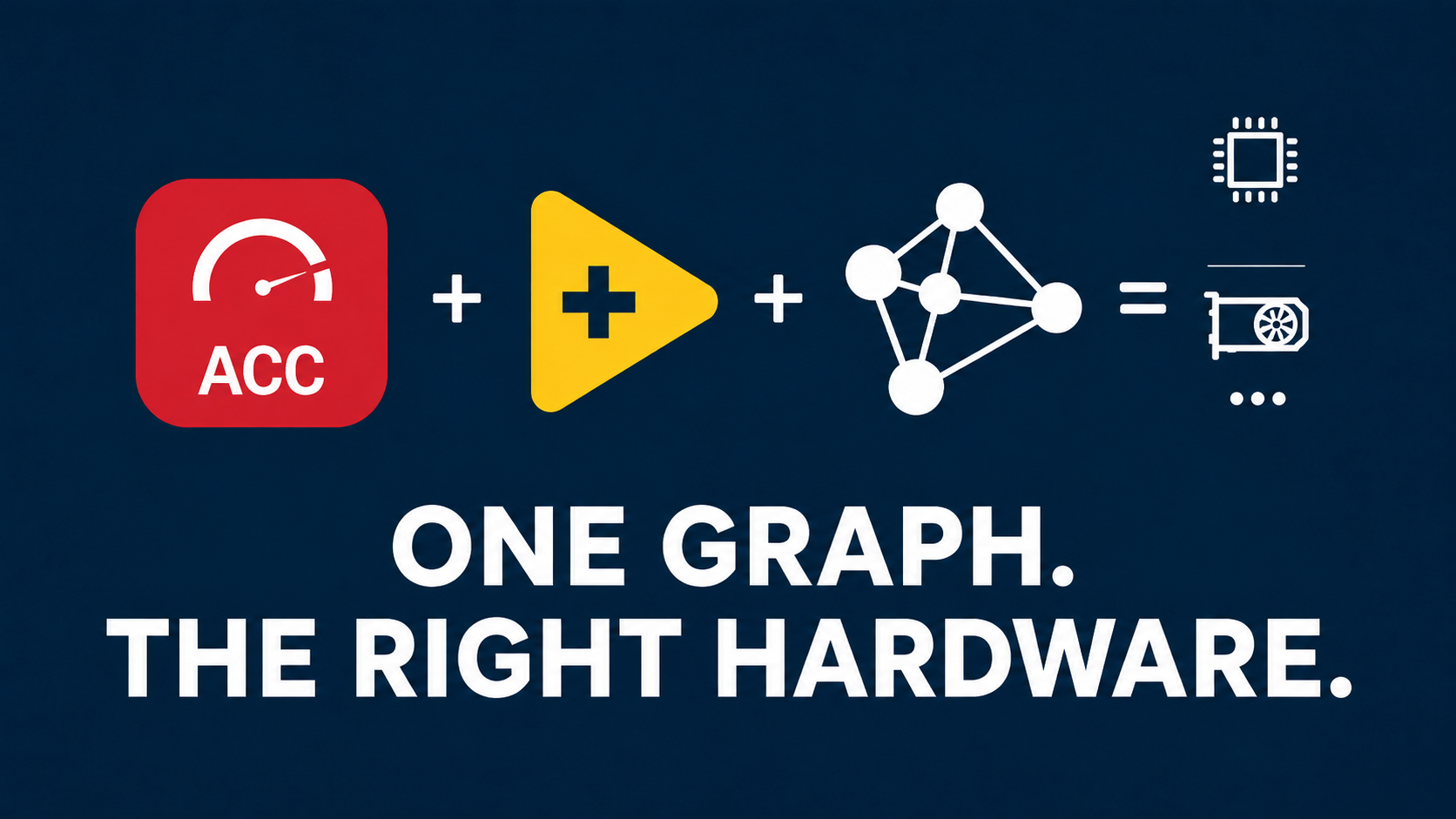
First, the source describes the graphical program. Then the system validates what that program means. Then it derives an execution-facing representation called FIR — FROG Intermediate Representation. Then this representation can be lowered toward a more specific backend. A backend contract can then describe what a runtime or compiler needs to consume. Finally, execution can happen through a runtime, a native compiler path, or another target-specific implementation.
The benefit is not complexity for its own sake. The benefit is traceability.
Each stage creates a point where the system can be inspected, tested, validated, or rejected. For industrial organizations, that is a major difference. It means graphical software can become more than a diagram on a screen. It can become a chain of accountable artifacts.
Why This Matters for Industrial Leaders
Industrial software is entering a new phase.
Machines are becoming more connected. Production systems are becoming more data-driven. Test benches are becoming more intelligent. AI is entering engineering workflows. Code can now be generated faster than teams can review it. Systems are expected to evolve more quickly, while remaining safe, traceable, and maintainable.
This creates a new problem: software production is becoming abundant, but software understanding is becoming scarce.
For industrial leaders, this is not a theoretical issue. When software drives equipment, test systems, robots, sensors, actuators, production tools, or mission-critical workflows, it is not enough to say “the code was generated” or “the application runs.” The important questions are different:
- Can we understand what the system does?
- Can we inspect the logic?
- Can we validate the transformation from design to execution?
- Can we preserve knowledge over time?
- Can we avoid being locked into one closed toolchain?
- Can we build confidence before deployment?
FROG is designed around those questions.
Its ambition is not only to make programming graphical. Its ambition is to make graphical programming open, inspectable, portable, and governable.
The Front Panel Becomes an Open Object Surface
One of the most important directions in FROG is the treatment of front panels and user interface objects.
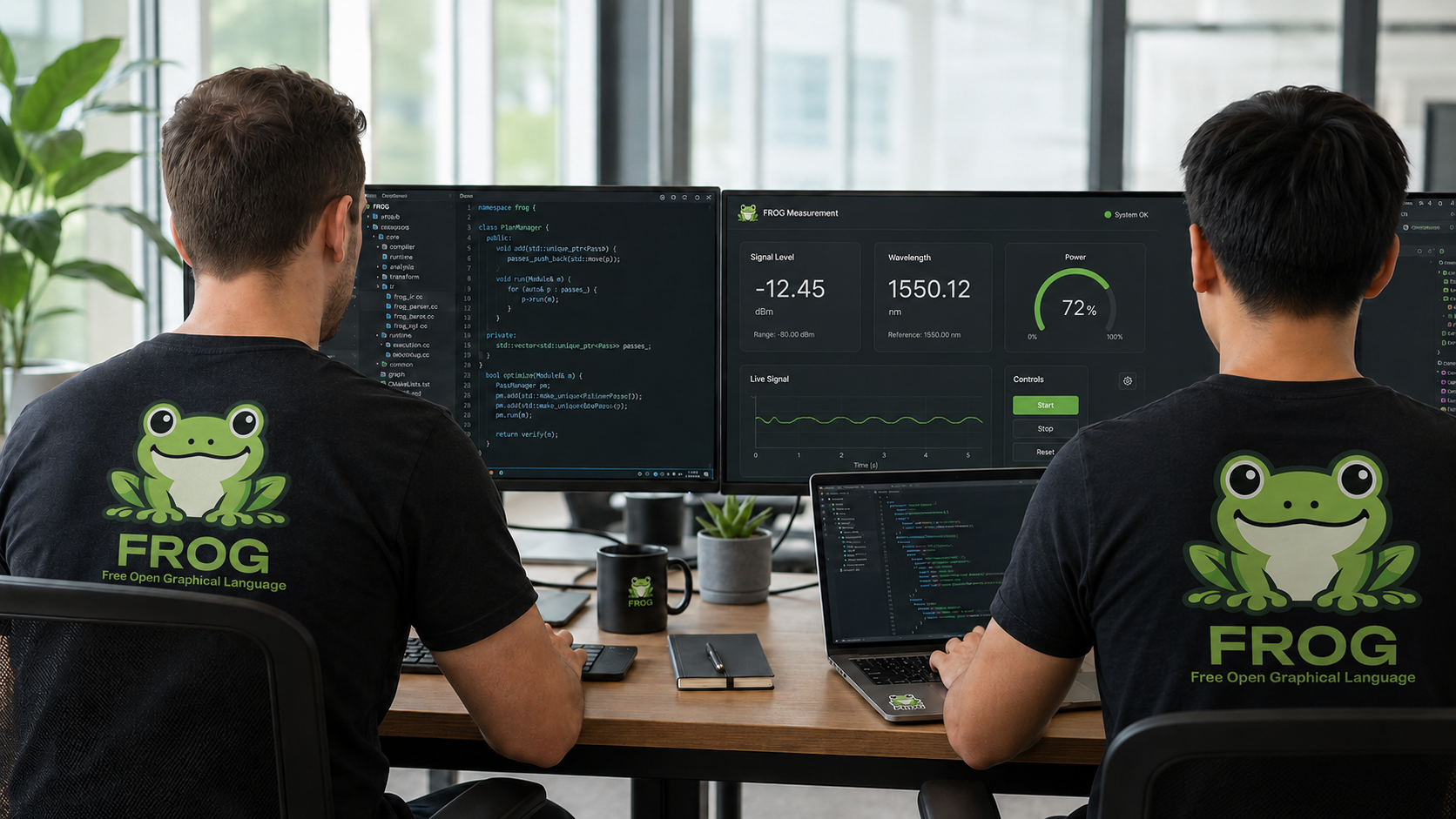
In many industrial applications, the user interface is not decoration. It is part of the operational system. Controls, indicators, numeric displays, buttons, plots, colors, states, and feedback surfaces are how engineers interact with the machine. They are also how operators understand what is happening.
FROG therefore does not treat the front panel as a secondary detail. The project is moving toward a model where UI objects can be described explicitly, connected to program logic, and carried as part of the broader language ecosystem.
This opens a very powerful possibility: graphical programs where the execution logic and the interface model remain structured, inspectable, and portable.
A key advantage here is that modern UI representation can benefit from standards such as SVG. SVG is resolution-agnostic by design: it describes shapes mathematically rather than as fixed pixels. That means a widget, icon, panel element, or graphical control can remain sharp across resolutions, screens, zoom levels, and display densities.
For industrial software, this matters more than it may seem. Test benches, embedded HMIs, supervision tools, engineering dashboards, and operator interfaces often live for years. They may move from one screen size to another, from one workstation to another, or from one deployment environment to another. A resolution-agnostic visual layer helps preserve clarity and usability over time.
The long-term idea is not simply to draw prettier panels. The idea is to make front-panel objects part of an open, inspectable, evolvable graphical language ecosystem.
Where FROG Stands Today
FROG is still under development. It should be understood as an open language foundation being actively built, not as a finished industrial product.
But the project has moved beyond pure intention.
The current repository already exposes functional example work around the path from graphical source to execution-oriented artifacts. The objective is to progressively prove that a FROG program can move through a disciplined chain: source, validation, intermediate representation, lowering, backend contract, runtime acceptance, and native execution proof.
That is an important step because it changes the nature of the project. FROG is no longer only asking people to imagine an open graphical language. It is beginning to show how such a language can be structured, checked, and executed through bounded examples.
The project is also careful about one important boundary: the reference implementation is not the language itself. This is essential. If one Python runtime, one LLVM path, or one UI host became the hidden definition of FROG, the project would recreate the very coupling it is trying to avoid.
Instead, the architecture keeps a clear separation:
- the language defines the meaning;
- the FIR exposes an execution-facing representation;
- lowering prepares backend-specific forms;
- contracts define consumable handoff surfaces;
- runtimes and compilers remain downstream implementations.
That separation is one of the most important ideas in FROG.
Why This Is Different from Building Another Tool
It would be easier to build a new graphical editor and call it a revolution.
But that would not solve the deeper problem.
The deeper problem is not that industry lacks screens with boxes and wires. The deeper problem is that graphical programming has often been trapped inside closed language substrates. The editor may be powerful, but the underlying program representation is not always open enough, portable enough, inspectable enough, or modular enough to support a broad multi-implementation ecosystem.
FROG starts lower in the stack.
It asks: what if the graphical language itself were open? What if the saved source were structured? What if the intermediate representation were inspectable? What if the runtime and compiler paths were modular? What if industrial graphical programs could be reviewed not only as diagrams, but as a chain of explicit artifacts?
That is a very different ambition from building one more proprietary environment.
Industrial Auditability as the Next Frontier
The next major frontier for FROG is industrial auditability.
This means giving organizations better ways to answer practical questions about their systems:
- Where did this logic come from?
- Was it written by a human, generated by AI, imported, reviewed, or modified?
- What source artifact owns the behavior?
- What was validated?
- What execution representation was derived?
- What backend contract was consumed?
- What runtime or compiler executed it?
- What behavior was expected?
- What behavior was observed?
This is where FROG becomes especially relevant in the AI era.
AI-assisted software generation will keep improving. But industrial trust will not come from generation alone. It will come from the ability to inspect, constrain, validate, review, and govern what was generated.
FROG is well positioned for that world because it treats program structure as explicit. A graphical source can be reviewed. A FIR artifact can be inspected. A lowering path can be checked. A backend contract can be tested. A runtime output can be compared against acceptance expectations.
This does not automatically make every program correct. Nothing does. But it gives industrial teams better control surfaces.
A Message to the LabVIEW Community
The LabVIEW community understands something many software communities sometimes forget: software is not only text. In engineering, software is often a system of signals, measurements, states, devices, timing constraints, user interactions, and physical consequences.
Graphical programming was powerful because it respected that reality.
FROG is being built with deep respect for that legacy. But it is also built from the conviction that the next era needs a more open foundation. The future of graphical programming should not be limited by closed representation, single-vendor execution paths, or opaque transformations.
The next era should allow graphical programs to be:
- openly represented;
- semantically validated;
- compiled or interpreted through multiple paths;
- connected to modern UI object models;
- portable across execution targets;
- auditable from source to runtime;
- ready for AI-assisted engineering without losing human control.
That is the direction FROG is taking.
What Comes Next
FROG is still in active development, and that matters. The project is not claiming that the future is already complete. It is building the foundation step by step.
The next work is about consolidation: stronger examples, clearer conformance, more robust runtime and compiler paths, richer front-panel object handling, and deeper industrial auditability. The goal is to move carefully from promising architecture to credible ecosystem infrastructure.
For industrial leaders, this is the right moment to pay attention. Not because FROG is already a finished replacement for existing tools, but because it addresses a structural question that will become more important every year:
How do we build industrial software that remains understandable, portable, inspectable, and controllable in an era where systems are becoming more complex and software generation is becoming faster?
FROG’s answer is clear: open the graphical language layer.
Conclusion
Graphical programming has already proved its value in industry. LabVIEW showed how powerful it could be when software, hardware, dataflow, and visual reasoning were brought together for real engineering work.
But the next step is not only a better editor. The next step is an open language foundation.
FROG is being developed to make graphical industrial programming more open, inspectable, portable, and accountable. It aims to preserve the practical intelligence of graphical dataflow while freeing the language layer from closed toolchain dependency.
In a world where AI can generate more software than humans can easily review, this matters deeply. The future will not only belong to those who can generate code. It will belong to those who can understand, validate, audit, and control the systems they deploy.
That is where FROG is going.
Explore the repositories
https://github.com/Graiphic/FROG
https://github.com/Graiphic/GO-Whitepapers