
After LabVIEW, Beyond Python: Why Graiphic Is Building FROG
For many engineers, LabVIEW was never just a tool.
It was proof that programming real systems does not have to begin with syntax. It showed that when you can see dataflow, timing, state, and interaction, you can reason about complexity differently. You can understand faster. You can debug faster. You can build with more confidence.
That idea still matters. In many ways, it matters more than ever.
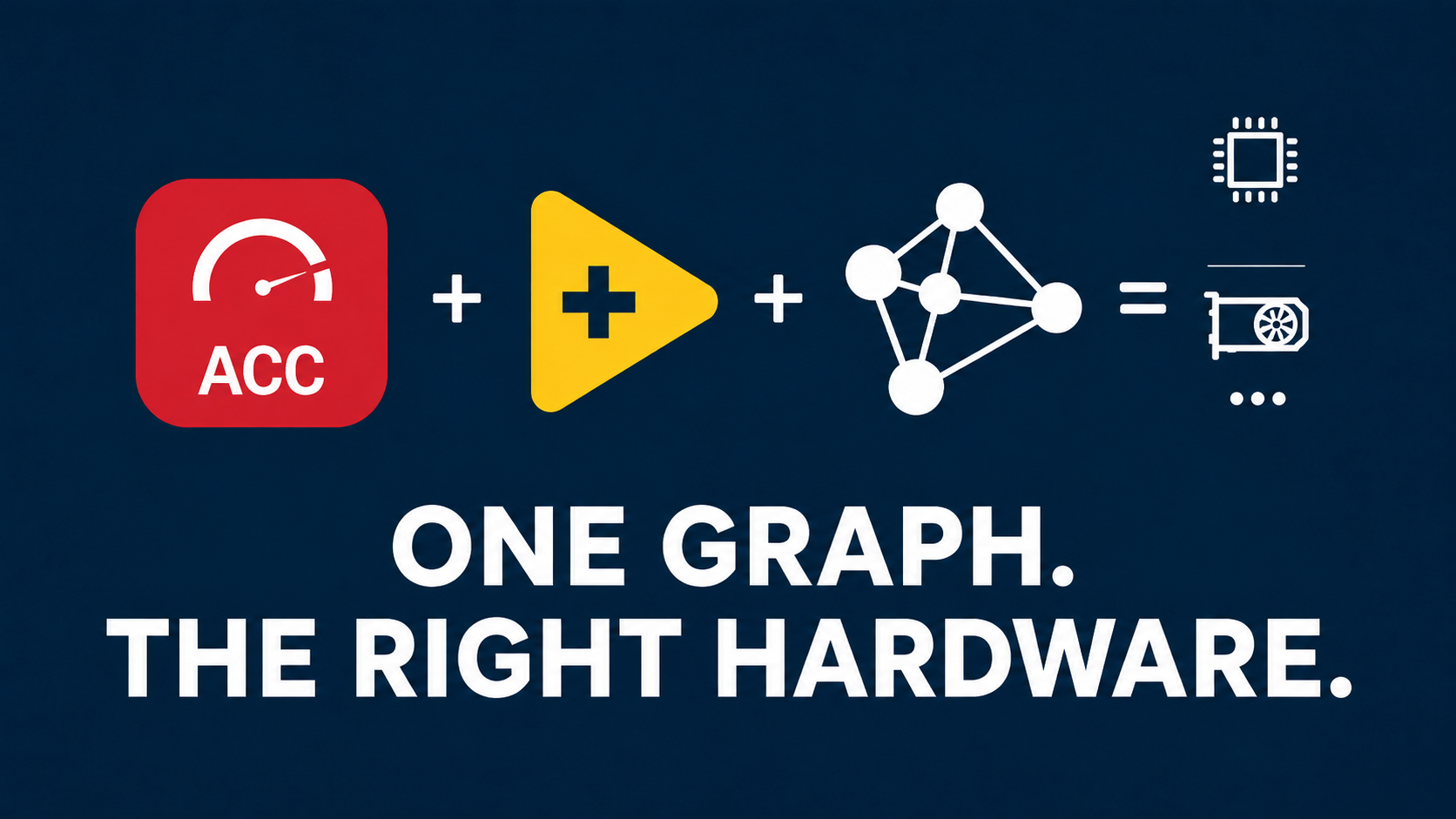
At Graiphic, GO HW was a decisive step in that journey. It pushed our graph vision beyond AI inference and toward system and hardware orchestration. It confirmed something fundamental. A graph can become much more than a model. It can become the foundation of how intelligent systems are designed, executed, monitored, and deployed.
But that journey also revealed a harder truth.
Once you push graphical orchestration far enough, you eventually hit a structural ceiling. As long as the graphical language itself depends on closed saved formats, opaque execution layers, or a toolchain that cannot truly be opened and standardized, the promise remains incomplete.
You can go far.
You cannot go all the way to full inspectability.
You cannot go all the way to full portability.
You cannot go all the way to full sovereignty.
That is why FROG exists.
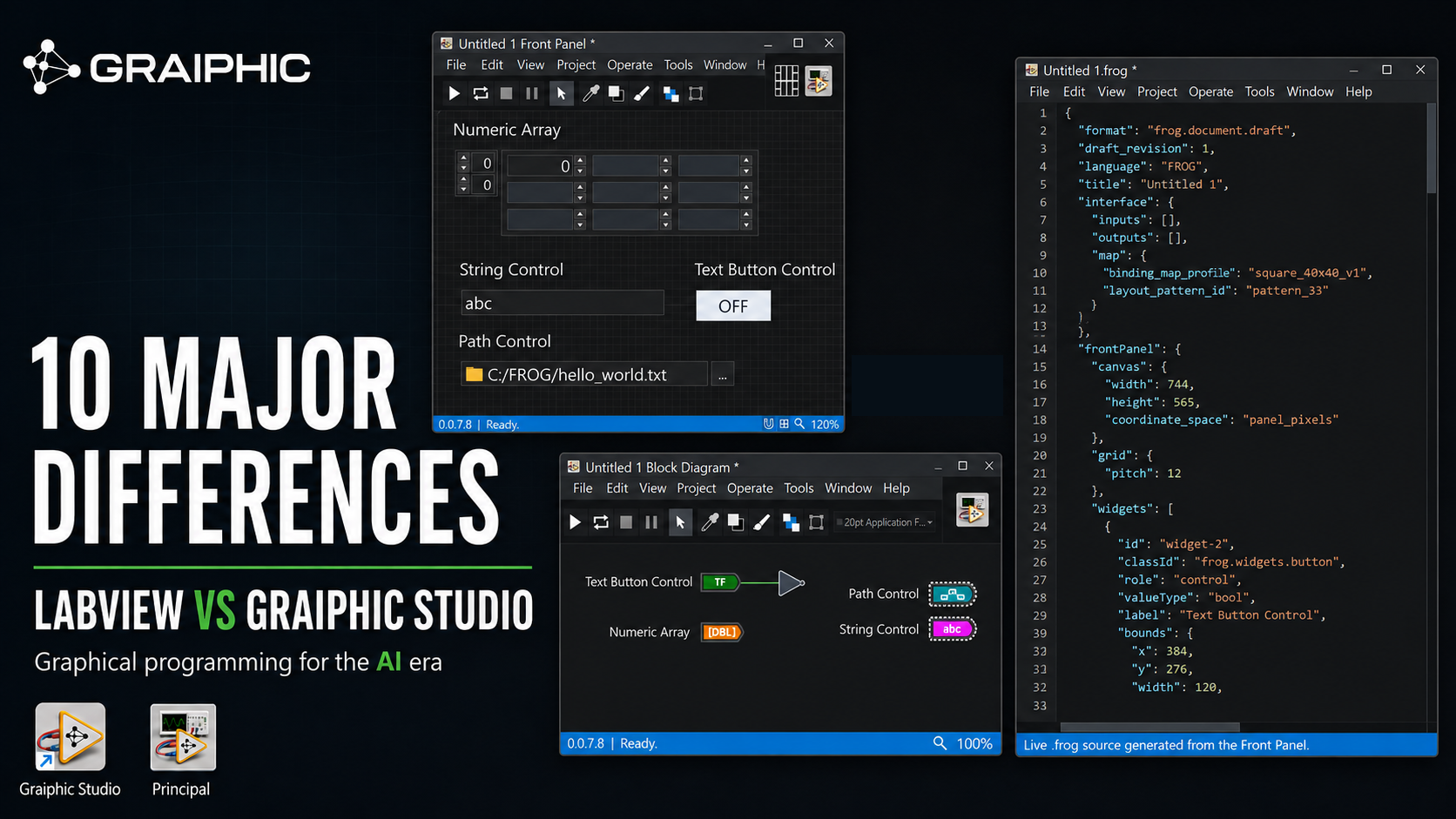
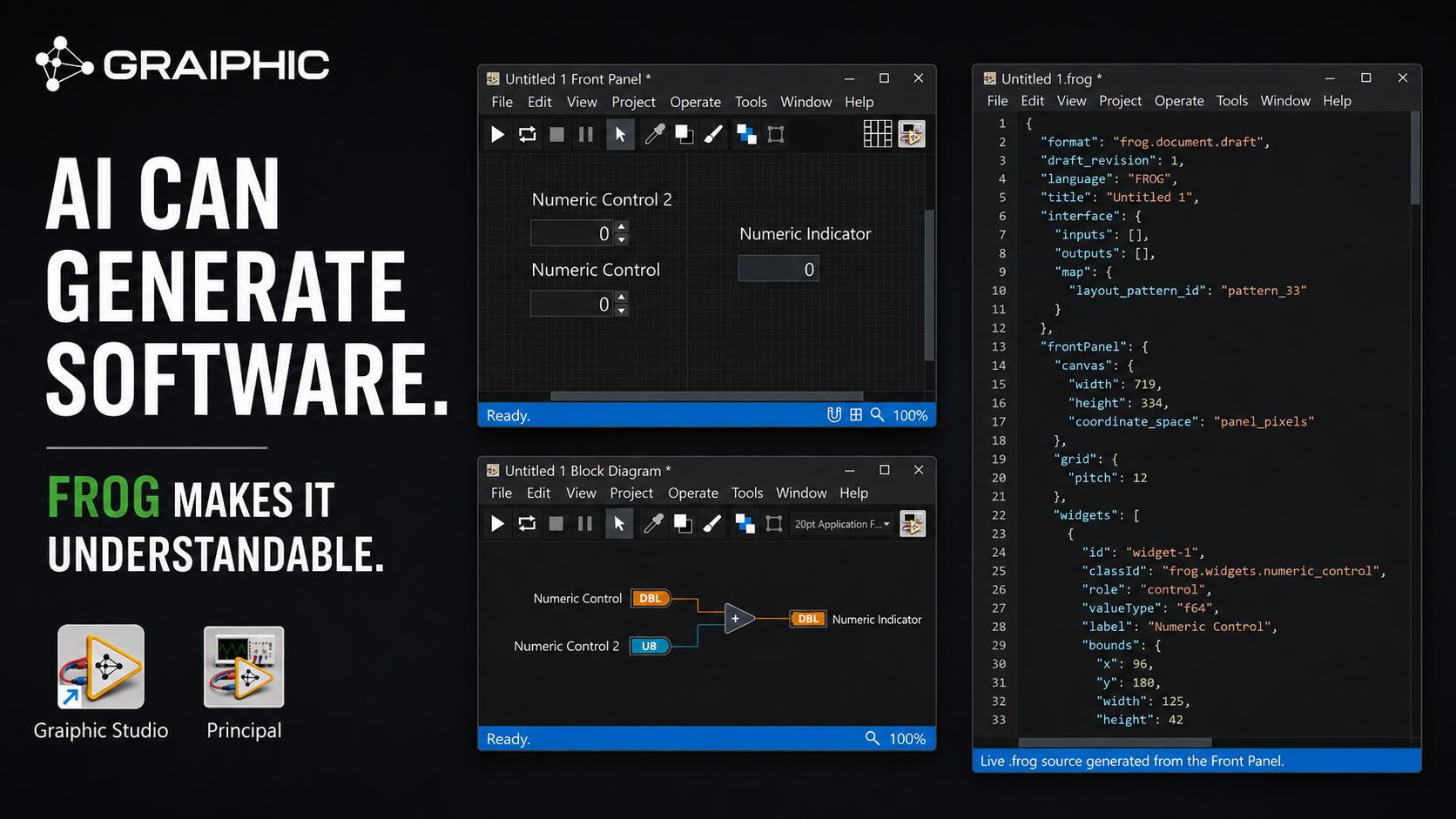
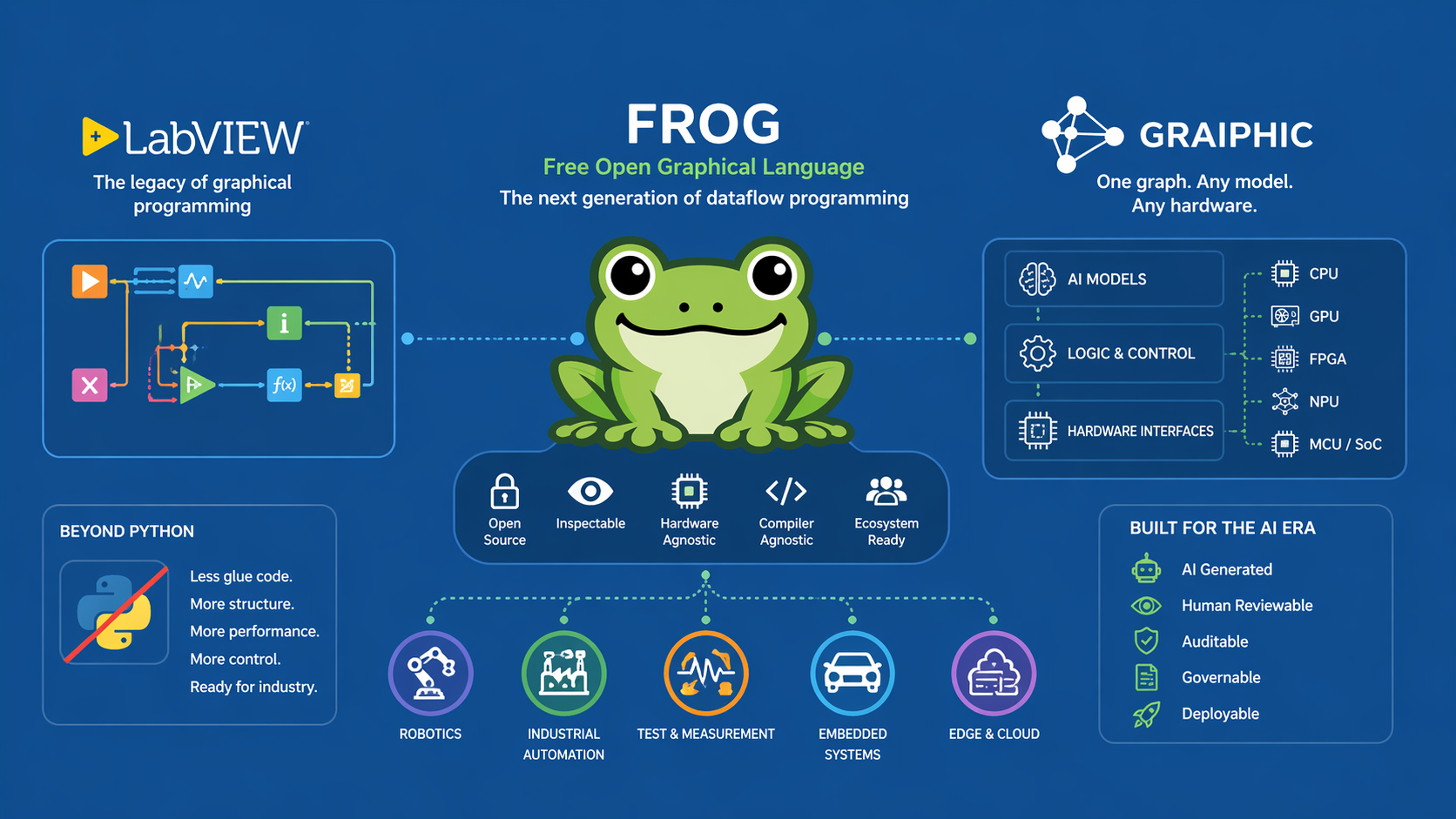
FROG, which stands for Free Open Graphical Language, is not just another IDE. It is our attempt to open the foundation itself. It is a modern graphical dataflow language designed for the AI era, with an open source format, a clear separation between language, IR, runtime, and IDE, and an architecture built to remain hardware agnostic and independent from a single compiler, runtime, operating system, or vendor stack.
The ambition did not shrink.
It moved down the stack.
In one sense, FROG is our answer to a dream that many engineers have carried for years.
What would it take to make serious graphical programming truly universal?
Not by copying the past.
Not by staying trapped in nostalgia.
But by taking what was powerful in graphical dataflow and reimagining it for a world of heterogeneous hardware, open standards, multiple runtimes, multiple compilers, and AI generated software.
A world where the language is not locked inside one vendor product.
A world where the graph remains visible, inspectable, and portable.
A world where graphical programming is not a niche convenience, but a serious industrial foundation.
Yes, this is also about Python
Python changed the world. It democratized AI, automation, prototyping, and research. It deserves that recognition.
But Python also became the default glue for too many systems that now need more structure, more determinism, more inspectability, and more deployment discipline. In labs, it is flexible. In industry, it too often becomes layers of scripts, wrappers, dependencies, hidden state, and accidental complexity.
Our ambition is not to erase Python everywhere.
Our ambition is stronger than that.
We want to make it possible, for a whole class of industrial and intelligent systems, to move beyond Python glue code toward something more explicit, more visual, more accessible to domain experts, more efficient to govern, and far easier to review at scale.
Less glue code.
More structure.
More visibility.
More control.
Why this matters now
This matters even more now because AI is changing software itself.
We are entering a world where software artifacts are increasingly generated, rewritten, transformed, reviewed, and validated by machines and humans together. In that world, representation becomes strategic.
The question is no longer only whether AI can generate code.
The real question is whether humans can still inspect it, control it, validate it, and trust it.
That is where graphical structure stops being a comfort feature and becomes an industrial advantage.
A graph can be reviewed.
A graph can be traced.
A graph can be discussed across teams.
A graph can make architecture visible again.
And in critical domains, that visibility is not cosmetic. It is part of governance. It is part of auditability. It is part of industrial trust.
The hard path is the sovereign path
Choosing to open the language layer is not the easy move.
The easy move is to add more wrappers.
More integrations.
More glue around existing stacks.
More local optimization around closed foundations.
The hard move is different.
The hard move is to open the file format.
To open the execution facing representation.
To standardize the language.
To separate semantics from execution.
To make room for an ecosystem larger than your own product.
But the hard path is also the sovereign path.
It is the path of long term control.
The path of long term inspectability.
The path of long term industrial independence.
That is why we believe this technological turn is necessary now.
Not later.
Now.
Because AI is accelerating the production of software.
Because hardware is becoming increasingly heterogeneous.
Because industrial systems need more readability, not less.
Because strategic sectors need more control over their execution stack, not less.
Because the next generation of tooling cannot rely forever on opaque foundations.
Open standard and product ambition
We also want to be clear about something.
Graiphic is not choosing between open standards and product ambition.
We want both.
FROG is meant to become an open foundation on which an ecosystem can grow. And Graiphic also intends to build a flagship proprietary IDE on top of that foundation. An environment ambitious enough to honor the legacy of the best historical graphical systems, but modern enough for AI, robotics, hardware orchestration, observability, runtime plurality, and compiler plurality.
This is not a contradiction.
It is the point.
An open standard allows an ecosystem to innovate.
A great product allows that ecosystem to reach excellence.
Why FROG matters
That is why FROG matters to us.
It is not just a project.
It is not just a language experiment.
It is not just a technical repository.
It is a strategic move.
A difficult one.
An ambitious one.
A foundational one.
We believe there is a missing zone to open in modern software systems.
A zone where accessibility meets system grade execution.
A zone where graphical programming is not shallow.
A zone where open standards do not weaken industrial seriousness, but strengthen it.
A zone where AI generated systems remain human governable.
A zone where programming becomes more inspectable, more portable, and more sovereign by design.
That is the future we want to help build with FROG.
And maybe the most exciting part is this.
Once the foundation is open, the innovations that can grow on top of it will go far beyond anything one company can imagine alone.
What if the next great software leap is not more code, but better representations for building, reviewing, and governing systems?
At Graiphic, we believe that question is worth pursuing.
And we believe FROG can become part of the answer.
Explore the repositories
https://github.com/Graiphic/FROG
https://github.com/Graiphic/GO-Whitepapers
Tags: #FROG #Graiphic #LabVIEW #Python #GraphicalProgramming #Dataflow #AI #OpenSource #IndustrialSoftware #EmbeddedSystems