
If you know us, you might raise an eyebrow: we are a French company, and we also run Technologies de France, the first French speaking LabVIEW community with a training YouTube channel, a LinkedIn channel, and an open GitHub presence.
So why Central Europe?
Because engineering communities are not about borders. They are about momentum, curiosity, and the quality of conversations. And right now, we see a strong technical energy in the Central Europe LabVIEW ecosystem: real world architectures, industrial constraints, and a clear appetite for the next chapter of LabVIEW, where AI is not a demo on the side, but a core capability of modern test and measurement systems.
A community that matches our direction
At Graiphic, we build tooling for engineers who ship systems, not slides.
We care about deployment, determinism, performance, reproducibility, and maintainability. We care about taking advanced AI and making it usable inside production grade workflows, including LabVIEW based environments.
Joining this user group is a practical move: it gives us a place to exchange with engineers who share the same reality, from test benches to embedded constraints, from lab prototypes to industrial rollouts.
What we want to bring to the group
Our goal is simple: contribute, share, and raise the technical ceiling together.
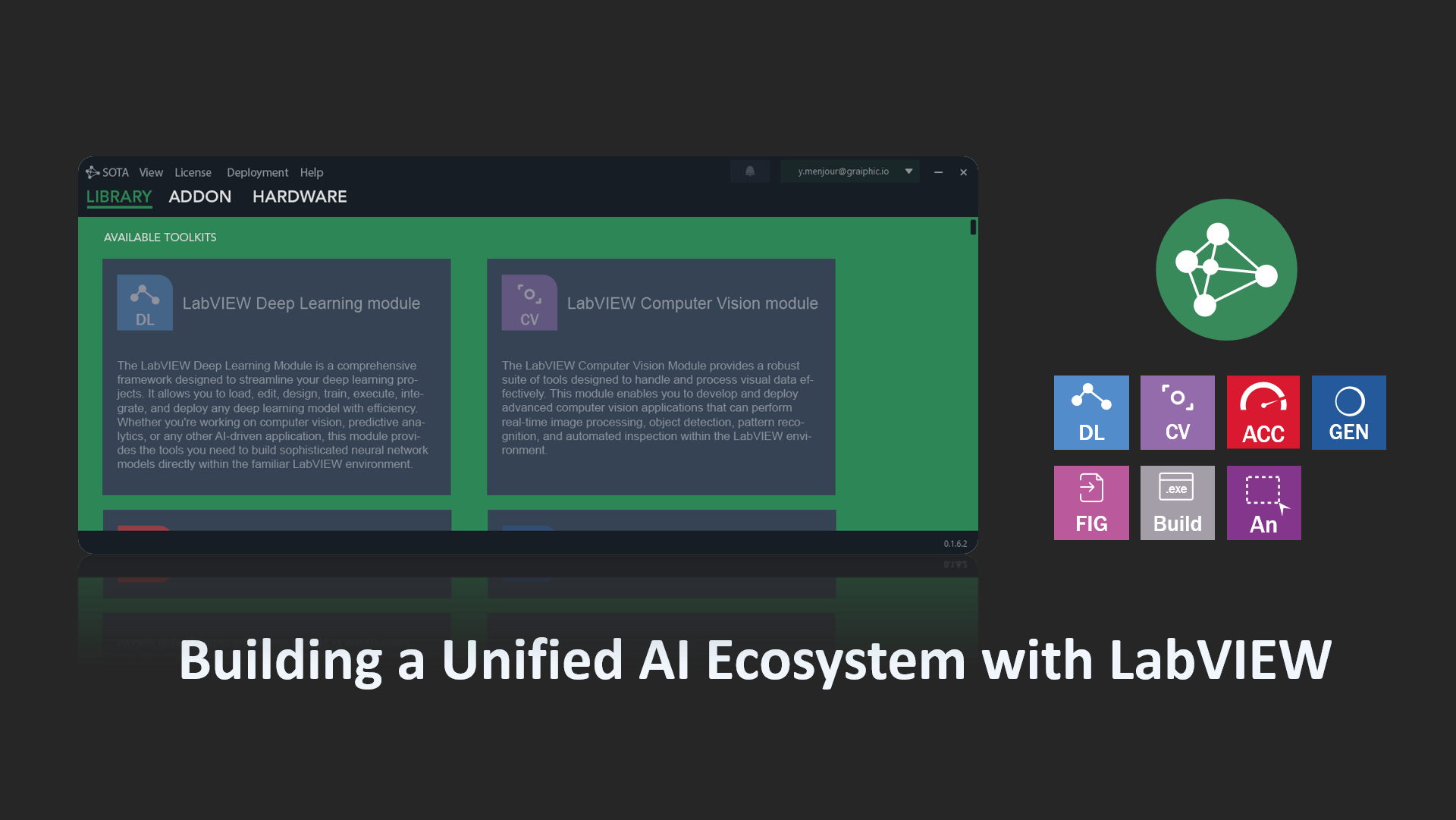
We plan to use this community to present what we call our SOTA sovereign development ecosystem. Concretely, this means showing toolkits that help teams build AI powered applications with LabVIEW, while keeping control of their stack, their deployment, and their performance.
Here are the four pillars we will bring to the table.
Deep Learning Toolkit
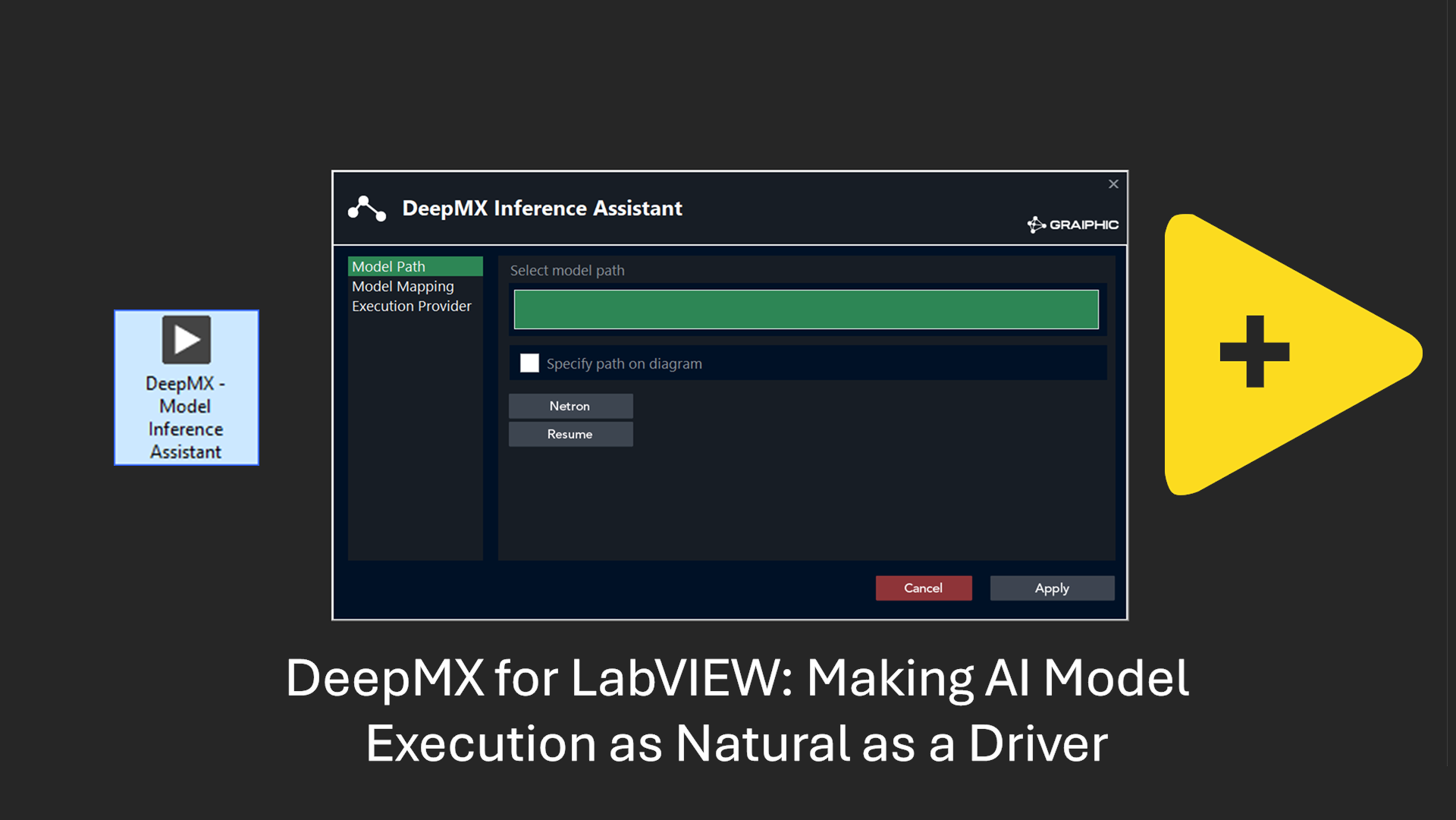
This is the part everyone expects, but we do it with a very pragmatic angle: fast inference, predictable deployment, and hardware aware optimization.
We will demonstrate how to run modern deep learning models inside LabVIEW driven workflows, with a focus on:
-
clean model packaging
-
consistent pre and post processing
-
scalable execution from CPU to GPU
-
performance oriented execution paths
The objective is not “AI in LabVIEW” as a curiosity. The objective is “AI as a reliable module in your test architecture”.
Computer Vision Toolkit
Vision is where AI becomes tangible. Sensors, cameras, lighting, timing, calibration, acquisition pipelines, and then inference.
We want to show how computer vision becomes a complete chain:
-
capture and synchronization
-
preprocessing for robust inference
-
postprocessing for actionable outputs
-
integration into test sequences and reporting
In other words, not just detection, but industrial vision workflows that fit into real systems.
Accelerator Toolkit
If AI is going to live inside test benches and edge devices, acceleration matters.
We will present how our ecosystem targets heterogeneous hardware and execution backends, with the right abstraction layers so engineers can:
-
prototype on a workstation
-
deploy on an edge box
-
scale on accelerated devices
Acceleration is not only about speed. It is also about cost, power, latency, and reliability. We aim to make those tradeoffs explicit and manageable.
GenAI Toolkit
GenAI is not only chat. It can be a productivity layer for engineering.
We want to explore practical, safe, and useful GenAI patterns for test and measurement teams, such as:
-
assisting with test sequence generation
-
automating documentation drafts
-
helping navigate large codebases and APIs
-
accelerating troubleshooting and knowledge transfer
Always with a clear boundary: engineering grade workflows, not vague magic.
What makes it “sovereign”
“Sovereign” is often used as a slogan. For us, it is a design constraint.
It means the ability to choose your deployment targets, control your dependencies, understand your runtime behavior, and avoid being locked into a single vendor or opaque stack.
In practice, we will show:
-
modular toolkits
-
clear interfaces between layers
-
repeatable build and deployment strategies
-
an ecosystem mindset that remains compatible with the LabVIEW world
New releases, roadmap, and what comes next
Joining the group is also a way to give more visibility to what we are building next.
We will share:
-
our latest toolkit updates and new features
-
the roadmap and the rationale behind it
-
the future developments we are prioritizing
-
the integration strategy between toolkits so they feel like one coherent platform
If you are working on large LabVIEW projects, AI based inspection, smart test orchestration, or hardware accelerated pipelines, you will recognize the problems we are targeting.
The fun part: real use cases, not theory
To keep things concrete, our content and talks will focus on scenarios like:
-
an AI assisted test bench that adapts measurements based on observed results
-
a vision driven inspection chain that produces structured, traceable outputs
-
an accelerated inference module that fits into deterministic test sequences
-
a GenAI assistant that speeds up engineering workflows without compromising process quality
We want it to be technical, but also enjoyable to follow. The kind of content that gives you ideas you can reuse the next day.
Join the conversation
We will introduce ourselves in the community forum, share examples, and open discussions around architectures, deployment patterns, and AI integration strategies that actually work in production.
If you are curious about AI inside LabVIEW based systems, or if you simply want to exchange with people building the next generation of engineering workflows, we would be happy to connect.
Graiphic is joining LabVIEW Usergroup Central Europe with one intention: contribute to a stronger, more modern, and more ambitious LabVIEW ecosystem in Europe.