

The AI ecosystem has grown at an incredible pace, but it has also become increasingly fragmented.
Training happens in one world (frameworks), deployment in another (runtimes), and hardware integration in yet another (vendor SDKs). Between them: glue code, brittle pipelines, duplicated logic, and systems that are hard to reproduce, hard to maintain, and expensive to industrialize.
At Graiphic, we chose a different direction.
We believe the future of industrial AI is not another framework. It is a unified engineering environment where models, logic, and hardware can be orchestrated together, visually, deterministically, and across hardware targets, using one graph as the source of truth.
Today, we’re excited to share a major milestone: we have published our full GO Whitepaper Series on GitHub.
Repository
https://github.com/Graiphic/GO-Whitepapers
Why four whitepapers?
Because our program is one unified stack seen from four complementary angles.
Each document can be read independently, but together they provide the full picture of what we are building: a sovereign, hardware-agnostic AI stack connecting AI, logic, knowledge, and hardware under one ONNX-native graph paradigm.
Here is what we released.
1) SOTA GO: the foundation, and the product we already built
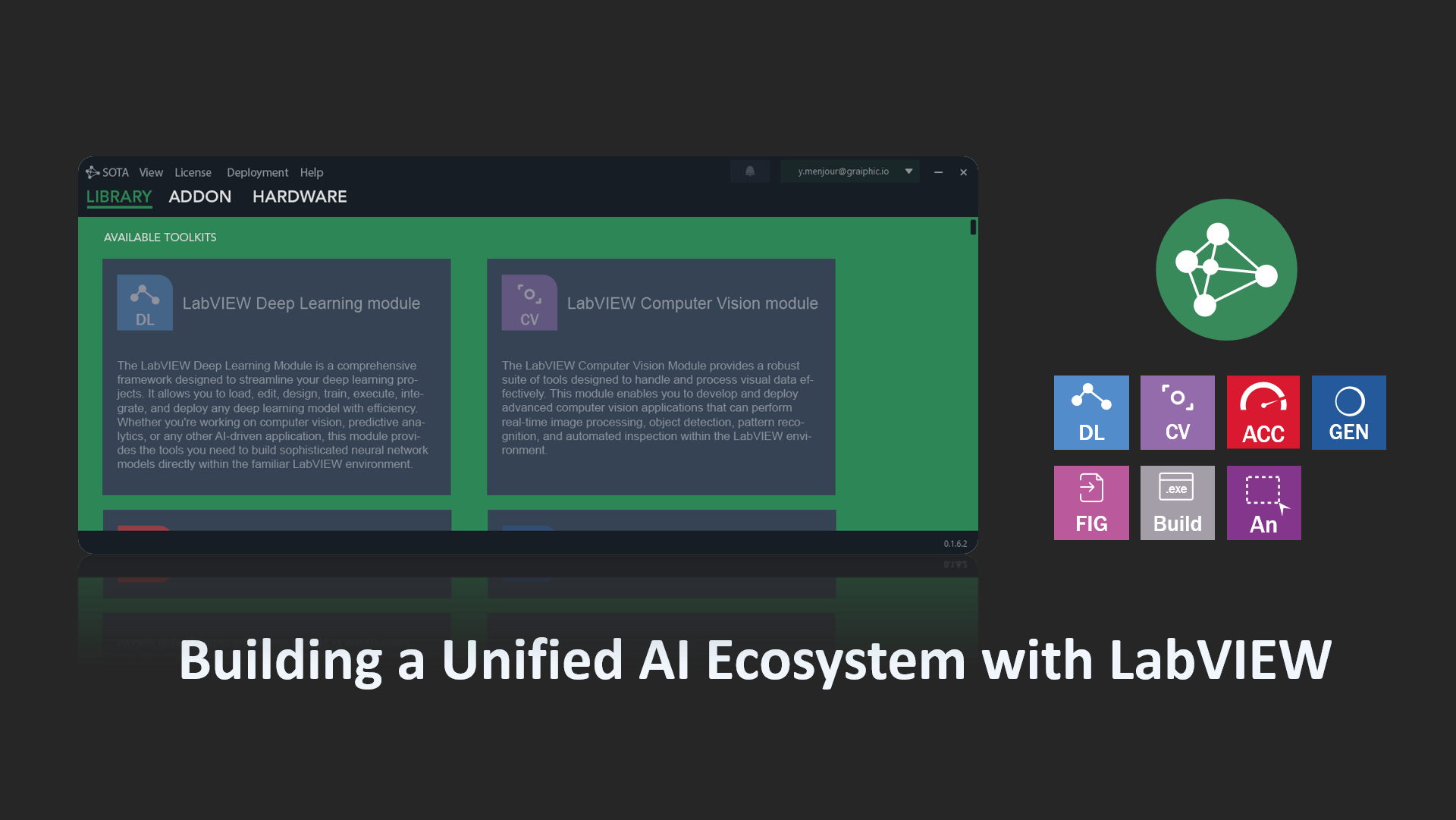
SOTA is the first building block of Graiphic.
For the last three years, we have been building SOTA as a LabVIEW-based Graph IDE where engineers can:
-
author and edit ONNX graphs visually
-
orchestrate execution flows, not just inference
-
integrate AI, system logic, and hardware constraints
-
deploy across targets with reproducibility and control
SOTA is not a prototype concept. It is functional and already available to industry, research labs, and academic institutions.
SOTA GO (v1.0)
https://github.com/Graiphic/GO-Whitepapers/tree/main/SOTA%20GO
2) GO HW: from models to systems
GO HW extends the graph beyond AI. It turns ONNX into a system-level orchestration language.
The goal is simple: unify logic, AI, hardware, and energy under one executable graph, deployable across CPUs, GPUs, FPGAs, NPUs, and embedded SoCs.
3) GO GenAI: from fragmentation to orchestration
Generative AI today is powerful, but operational pipelines are often fragile and overly dependent on Python glue code.
GO GenAI proposes a unified execution fabric where models, tokenizers, RAG flows, logic, and runtimes are orchestrated within a graph-first approach, fully compatible with SOTA.
4) GO IML: from theory to superiority
GO IML addresses a deep limitation of data-only learning: weak generalization outside training distributions.
By embedding physics, constraints, logic, and expert knowledge directly into ONNX training graphs, GO IML enables robust, explainable, hardware-portable models designed for real-world environments.
The core idea: one graph, one runtime, one cockpit
If we had to summarize the program in one sentence:
One graph as the source of truth. One runtime for execution. One visual cockpit for design and orchestration.
That cockpit is SOTA. And that is why SOTA is the foundation of everything we publish and build.
What happens next
Publishing these whitepapers is not the end of a story. It is the beginning of a clear, public technical roadmap.
We will continue to:
-
expand SOTA as the unified industrial Graph IDE
-
solidify deterministic deployment and hardware orchestration
-
deepen ONNX-native support for GenAI orchestration and informed learning
-
build partnerships around a hardware-agnostic, certifiable stack
If you are an industrial team, a research lab, or an academic group looking for a serious, deployable graph-based approach to AI systems, we’d love to talk.
Contact
hello@graiphic.io
Website
https://www.graiphic.io
Whitepapers
https://github.com/Graiphic/GO-Whitepapers