
Where
Description
Return elements, either from X or Y, depending on condition. Where behaves like numpy.where with three parameters. This operator supports multidirectional (i.e., Numpy-style) broadcasting; for more details please check Broadcasting in ONNX.
Documentation illustration (illustration unavailable in the archive).
Input parameters
 specified_outputs_name : array, this parameter lets you manually assign custom names to the output tensors of a node.
 Graphs in : cluster, ONNX model architecture.
 condition (heterogeneous) – B : object, when True (nonzero), yield X, otherwise yield Y. X (heterogeneous) – T : object, values selected at indices where condition is True. Y (heterogeneous) – T : object, values selected at indices where condition is False.
Documentation illustration (illustration unavailable in the archive). Parameters : cluster,
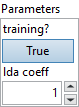
 training? : boolean, whether B should be transposed on the last two dimensions before doing multiplication.
Default value “True”.
 lda coeff : float, defines the coefficient by which the loss derivative will be multiplied before being sent to the previous layer (since during the backward run we go backwards).
Default value “1”.
 name (optional) : string, name of the node.
Output parameters
 output (heterogeneous) – T : object, tensor of shape equal to the broadcasted shape of condition, X, and Y.
Type Constraints
B in (tensor(bool)) : Constrain to boolean tensors.
T in (tensor(bfloat16), tensor(bool), tensor(complex128), tensor(complex64), tensor(double), tensor(float), tensor(float16), tensor(int16), tensor(int32), tensor(int64), tensor(int8), tensor(string), tensor(uint16), tensor(uint32), tensor(uint64), tensor(uint8)) : Constrain input and output types to all tensor types (including bfloat).
Example
All these exemples are snippets PNG, you can drop these Snippet onto the block diagram and get the depicted code added to your VI (Do not forget to install Deep Learning library to run it).