
SequenceLength
Description
Produces a scalar(tensor of empty shape) containing the number of tensors in ‘input_sequence’.
Documentation illustration (illustration unavailable in the archive).
Input parameters
 specified_outputs_name : array, this parameter lets you manually assign custom names to the output tensors of a node.
 input_sequence (heterogeneous) – S : object, input sequence.
 Parameters : cluster,
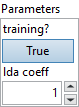
 training? : boolean, whether the layer is in training mode (can store data for backward).
Default value “True”.
 lda coeff : float, defines the coefficient by which the loss derivative will be multiplied before being sent to the previous layer (since during the backward run we go backwards).
Default value “1”.
 name (optional) : string, name of the node.
Output parameters
 length (heterogeneous) – I : object, length of input sequence. It must be a scalar(tensor of empty shape).
Type Constraints
S in (seq(tensor(bool)), seq(tensor(complex128)), seq(tensor(complex64)), seq(tensor(double)), seq(tensor(float)),
seq(tensor(float16)), seq(tensor(int16)), seq(tensor(int32)), seq(tensor(int64)), seq(tensor(int8)), seq(tensor(string)), seq(tensor(uint16)), seq(tensor(uint32)), seq(tensor(uint64)), seq(tensor(uint8))) : Constrain to any tensor type.
I in (tensor(int64)) : Constrain output to integral tensor. It must be a scalar(tensor of empty shape).
Example
All these exemples are snippets PNG, you can drop these Snippet onto the block diagram and get the depicted code added to your VI (Do not forget to install Deep Learning library to run it).